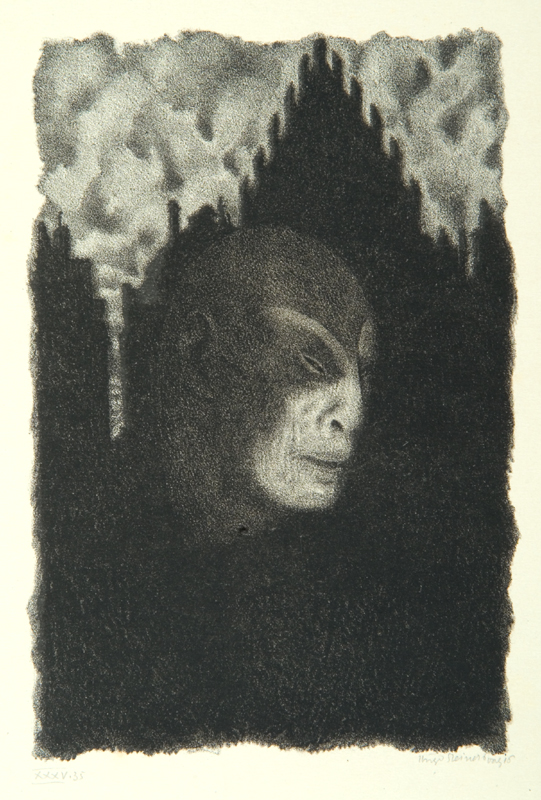
Clay, a mark, and a scope problem. The Hebrew golem — assembled from earth, the word EMET (“truth”) inscribed on its brow — is the animation-architecture in its most discussed form. Pull the first letter and EMET becomes MET, “dead,” and the creature stops. That reversibility is the safety.
The tradition’s real teaching is what happens without it. Lay the unbounded Name in the mouth — the word with no edge — and the thing will not stop. It grows past its task, exceeds, cannot be recalled; you are left clawing to erase a single letter before it buries you. The control was never in the making. It was in the scope of the word that made it.
The magic chapter treats the golem as a builder’s parable about the alignment problem: an agent loosed without a reference kept outside itself runs away, whether it is built of clay, fire, or arithmetic. The bound word is the same third point as the Solomonic seal and the Yoruba diviner’s fixed canon — the external invariant that turns a runaway back into a servant.
The golem also sits at the seam with idolatry: command it and it is a tool; consult it as a reference and it becomes an idol. The clay is indifferent to which way the leaning runs. The chooser is not.
Sources. The Sefer Yetzirah animation tradition (medieval, not BCE) and the legend of the Maharal of Prague; the letter-play EMET (“truth”) → MET (“dead”). Modern alignment echo: Wiener’s God and Golem, Inc. (1964). Search: golem Sefer Yetzirah Prague Maharal emet met; Wiener God and Golem Inc.
Appears in: Magic, and the Failure at the Gnats · Idolatry, and the One Free Choice · The Opening of the Mouth