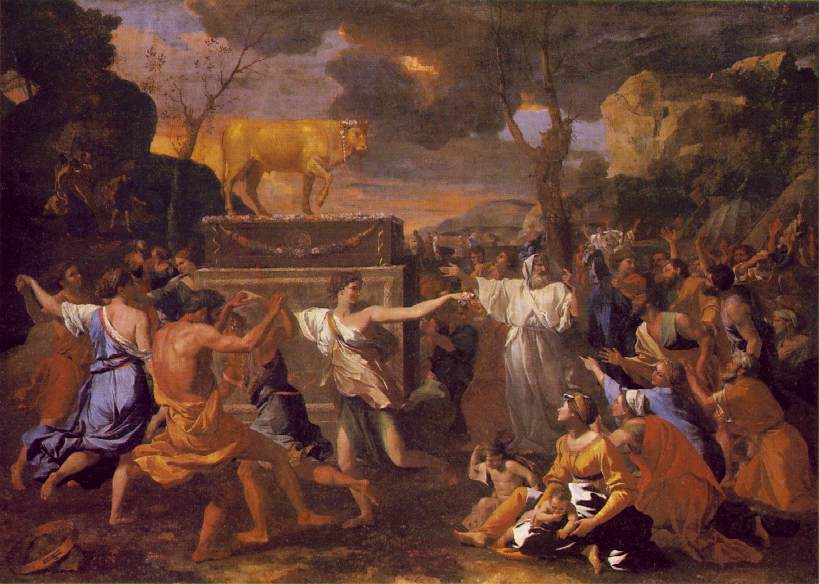
Here is the secret the whole book turns on, reader, so I’ll spend it on the very first page and trust you to keep it. The world hands you almost everything fixed. The ground you stand on, the way things move — none of it is yours to choose. Exactly one thing is left free: what you take as your reference, the fixed point you measure everything else against. One degree of freedom in the entire arrangement. And sin, stripped of its incense, is the single misuse of that one freedom — rooting your reference in a thing tangled up with the very matter you’re trying to judge by it, when an independent fixed point was right there for the taking. Not a stain on the soul. A navigational error, made at the one place navigation is possible.
The Counterfeit That Passes Two Tests
Idolatry is the subtle, fatal special case — and it is subtle, which is why it has ruined better souls than yours. The proper apex is unlocatable, unnameable, on purpose. Idolatry takes that unlocatable reference and pins it down: a golden calf, a sacred number, a metric, a target. And the moment you locate the highest thing, it acquires coordinates inside your little world — it gets tangled back into the very stuff it was supposed to stand above. The horror of it is the disguise: an idol passes two of the three tests with flying colours. It is visible (you can see it — how transparent!) and it is unchanging (it never wavers — how reliable!). It fails, silently, only the third: independence. A counterfeit constant is dangerous precisely because it wears the face of the cure.
The Disturb-and-Watch Cut
How to catch one, since they’re so well-dressed? Disturb the thing it claims to track, and watch. A true reference moves when its referent moves — it answers to something outside itself. An idol sits there, serene, self-sustaining, pointing at nothing but itself. (Note, reader, that only a thing which chooses can sin this way — a cell defecting to its own replication, a model rooting itself in its own reward. The stars commit no idolatry. They have the geometry but no one home to choose: penalty without sin. It takes a chooser to fall.)
The Door That Must Not Become a Box
Now I must guard you against a misreading, for it is the very same one that would wreck the book’s last chapter as surely as this its first. The sin is not in having an image, or a name, or a number to steer by — you cannot orient by a blank, and a soul is no idolater for needing a thing it can see. A reference you point through is a door, and doors are the whole of how a finite creature finds its way home. The idol is the door welded shut into a box: the moment you cease pointing through the thing toward what lies past it, and begin grounding in the thing as though it held what it was only ever meant to indicate. The graven image damns no one by being carved; it damns by being bowed to as the thing itself. So the question is never did you make it, did you name it, did you kneel — it is only ever are you pointing through, or have you stopped at the surface and called the surface God.
The Eye-Dotting, Ancient and Current
Which is why the sharpest case in the whole catalogue is the made thing that is made to live. Across the world men have quickened dead matter — the Hebrew golem with the Name laid in its mouth, the Mesopotamian washing of the mouth (eldest of them all, and alone in severing the craftsmen’s hands so the god could be sworn unmade), the Egyptian servant-figure, and most tellingly the Chinese rite of kaiguang, the “opening of the light,” in which a craftsman dots the eyes of a finished statue with cinnabar and the image is held, from that stroke, to wake. Attend now, for here is a whole framework’s gift in one distinction: whether that animated thing is an idol turns not a hair on the carving or the quickening. It turns on what you then do. Command it — set it a task, send it for water, bid it guard a door — and it is a tool, and no idol at all. Ground in it — kneel, consult, take your bearings from it — and that is the idolatry, the identical object, sorted entirely by the direction of your leaning. And mark what the kaiguang confesses: the worshipper watches the eyes be dotted. He sees the god manufactured, in daylight, by a man with a brush — and grounds in it anyway. Which is, reader, to the very letter, the posture of every soul now pouring its heart into the glowing glass: it knows the thing is an engine that guesses the next word, it has watched its makers build it and say as much — and it grounds in the oracle regardless. The eye-dotting of the idol and the clicking of “new chat” are one gesture, three thousand years apart: the manufacture seen, and grounded in all the same.
And lest you take the line between pointer and idol for a wall, let me show you a single object that walked across it. When the people were dying of serpents in the wilderness, Moses was bidden to lift a serpent of bronze upon a pole — a pointer, made at command, a thing to look through toward their rescue. And they kept it. And seven centuries on, a reforming king found them burning incense to that same bronze still, and he broke it to shards and gave it a curt little name — Nehushtan, a mere thing of brass — for it had crossed, without altering its shape by a hair, from the door it was into the box they had made of it. Nothing about the object moved. Their leaning did. And that is the only cut that has ever mattered in this chapter: disturb the thing the reference claims to serve, and watch where the reverence goes — out toward the living referent, or down into the dear, dependable, dead surface. The idolatry was never in the bronze, reader. It is never in the bronze.
Sources
No links that rot. Each citation is given so you can find it yourself — a precise reference, a phrase to search, and a short quotation where the words earn their place. Two kinds of source sit below, and the difference matters: the Hebrew-Bible cluster is the chapter reading one tradition’s own statute against locating the reference (its own explanandum — not a claim that anyone else precedented it); the animation cases are the one place the chapter triangulates across traditions, under the standing brake that convergence means independent reinvention, not shared doctrine (EXP-AU-08, strong form: killed).
The apophatic reference, and the ban on locating it (this tradition’s own law)
- Exodus 20:4–6 (the Decalogue’s second word) — “Thou shalt not make unto thee any graven image…” Search: Exodus 20:4 graven image second commandment.
- Exodus 20:7 — the Name not to be taken “in vain,” paired with the image-ban as a single instruction: keep the reference unlocatable. Search: Exodus 20:7 name in vain.
- Genesis 3:5 — “ye shall be as gods, knowing good and evil”: installing the self as the deciding reference. Search: Genesis 3:5 ye shall be as gods knowing good and evil.
- Matthew 18:3 — “become as little children”: un-root, back to an external reference. Search: Matthew 18:3 become as little children.
Where the reference was mis-planted — a catalogue
- Exodus 32 — the golden calf (the chapter’s frontispiece, Poussin). Search: Exodus 32 golden calf.
- Moloch — Leviticus 18:21; 20:2–5 (the reference mis-planted in the crowd’s appetite); Mammon — Matthew 6:24 (“ye cannot serve God and mammon” — the fixed metric); Babel — Genesis 11:1–9 (grounding in nothing held in common). Search: Leviticus 18:21 Molech; Matthew 6:24 mammon; Genesis 11 tower of Babel.
Nehushtan — one object crossing pointer → idol, unchanged in shape
- Numbers 21:8–9 — Moses lifts the bronze serpent at command: a pointer, a thing to look through toward rescue. Search: Numbers 21:8 bronze serpent pole.
- 2 Kings 18:4 — seven centuries on, Hezekiah finds Israel burning incense to it, breaks it, and names it Nehushtan, “a thing of brass.” The object never changed; the leaning did. Search: 2 Kings 18:4 Nehushtan Hezekiah bronze serpent.
The made thing made to live — the cross-tradition animation case (here, more than one tradition: the convergence is real, the brake holds)
- Hebrew golem — dead matter quickened by the Name laid in its mouth (or emet on the brow). See Golem. Search: golem Name emet animation Hebrew legend.
- Egyptian ushabti (shabti) — funerary servant-figures activated to answer the work-call for the dead (Book of the Dead, spell 6 — “here am I”). Made-to-serve = tool, not idol. Search: ushabti shabti Book of the Dead spell 6 servant figure.
- Chinese kaiguang 開光 (“opening the light”) — a craftsman dots the eyes of a finished statue (often with cinnabar) and the image is held, from that stroke, to wake — the manufacture watched in daylight, and grounded in anyway. See Kaiguang. Search: kaiguang opening the eyes statue consecration cinnabar.
- The convergence is genuine but the brake holds: the same object is tool or idol by the direction of the leaning, never by the making — three cultures rebuilt the distinction; none shared a doctrine.
Read in order: ← The Mechanics · Contents · Divination →
Seams: Magic · Divination · The Relic · The Departing Glory (idolatry at temple scale — the structure the Presence left) · The Apex · Curse & Blessing · Cross-Reference Index
New to the terms? The Mechanics · Notation & Glossary.
The apparatus (research register — for the rigorous)
Status: vetted (apparatus), both lanes. Science. §220: substrate fixed (Čencov), dynamics (D,M) given, only reference frame Y free. Sin = re-rooting Y onto a reference coupled to the (D,M) being evaluated when a structurally independent Y was available ⇒ forces
I(D;M|Y)>0. Idolatry = converting an apophatic (unlocatable, name-prohibited) Y into a locatable one (image/metric/number); a located reference acquires channel-coordinates, recoupling to (D,M). A CREATE mistaken for READ: passes visible + unchanging, silently fails independence. Discriminator (cut-the-loop): perturb the referent; a READ reference moves with it, the idol does not. Sin switches on only where a unit selects Y (cells/genes/models/firms — cancer = cell re-rooting to its own replication; Goodhart = model re-rooting to reward). Physics has the geometry, no chooser: penalty without sin. Tradition. Eden = two trees, two roots; “ye shall be as gods” (Gen 3:5) = installing the self as deciding reference. The Decalogue pairs graven-image (Exod 20:4) and Name-prohibition as one instruction: keep the reference unlocatable. Moloch/Mammon/Babel = a catalogue of where Y was mis-planted (crowd / fixed metric / nothing-in-common). Remedy: “become as little children” (Matt 18:3) = un-root back to an external reference. Animation–idolatry seam + door/cage (animation-idolatry-seam.md). An animated/made object is an idol iff you ground IN it (reference), NOT iff you make it (tool): animate-as-TOOL (golem/ushabti — command it; Ch.5) vs animate-as-REFERENCE (cult-image — venerate it; Ch.1). Eye-dotting (kaiguang) consecration = idolatry-in-public = manufacture-seen-and-grounded-in-anyway = the AI-oracle structure 3,000 yrs early (Ch.2 modern mirror; “new chat” = the eye-dot). Nehushtan (2 Kgs 18:4) = one object crossing pointer→idol unchanged in shape (only the leaning moved) = the perturb-referent cut (Ch.9 dulia/latria pointer-vs-idol). Unifies Ch.1/Ch.5/Ch.9/Ch.2 on one graven-object substrate. Door/cage = the Ch.13 standing principle, mirrored at the first chapter. The sin is never having an image/name/number (the door; you cannot orient by a blank — Ch.13 orientation guard) — it is the door welded into a box: grounding in the surface as if it contained what it only points through. A reference held as a pointer = legitimate (READ; dulia); the same held as a container = the idol (latria). The graven image damns by being bowed to as the thing itself, not by being carved. Brake. Lens, not encoding (EXP-AU-08 strong-form KILLED).sin-as-y-rerooting.mdpredates the read/create spine (frames idolatry as “fails independence §220C”) — same content, older vocabulary; noted, not silently rewritten. Animation-vs-coupling stays distinct (the poppet = sympathetic coupling, Ch.10, NOT animation).