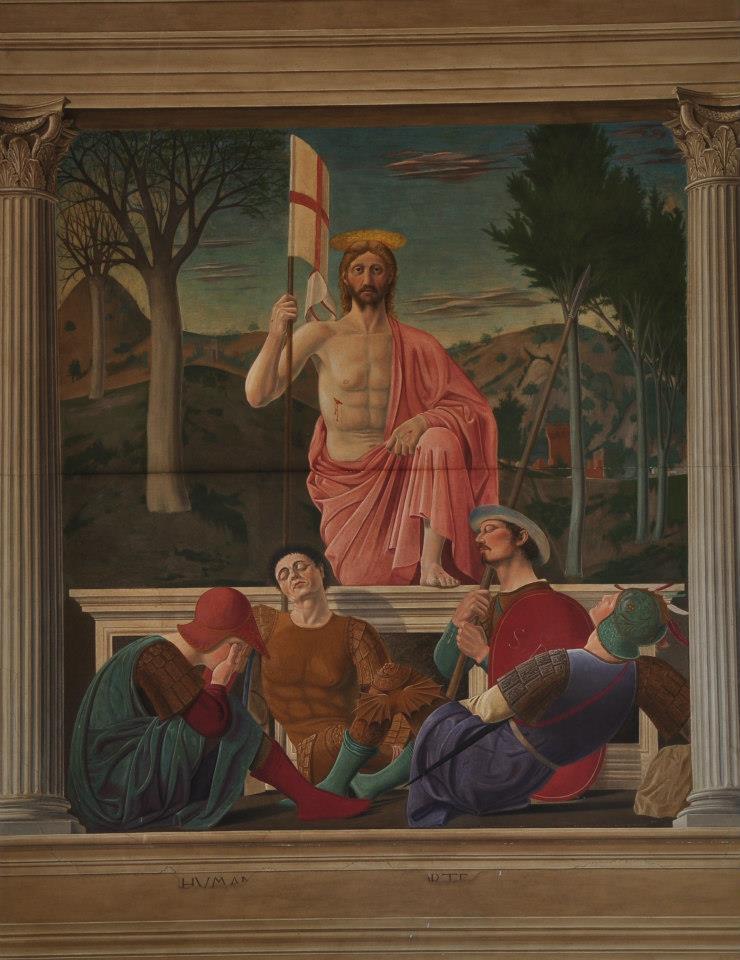
We come, reader, to the last edge, and the deepest — and I find I must begin by reminding you what this whole book has been for. Every page has turned on one act: cut the loop, and see what holds. The ouroboros — the creature whose name we borrowed for the cover — is the thing that will not let the loop be cut: the snake with its own tail in its mouth, the immortality that is only a refusal to die, the flask and the upload, keep me running, do not let it close. And death, reader, is the loop cut whether you consent to it or not — the one perturbation no soul evades. So there was always going to have to be a last chapter about the far side of that cut. The necromancy of my fourth chapter was one answer to it: reach back across the cut and consult what has been severed. This is the other answer, and it runs the opposite way — not a hand reaching back across, but a thing carried forward across, restored from the far side by a hand that is not your own.
You Cannot Raise Yourself
And here is the one thing this operation insists upon, the iron spine of it: you cannot raise yourself. A thing that hauled itself back across the cut would be a loop closing upon itself — two points, the riser and the risen one and the same — which is to say it would be the ouroboros all over again, the cancer-cell’s exact bargain: buy your own endlessness by defecting from the body you were meant to serve. Real restoration must arrive from a point outside the thing being restored. And so, of every operation in this whole catalogue, this one is the most three-point — the external reference taken to its absolute limit — precisely because the dead cannot reach for it and the mourner cannot supply it; it must come from higher than the both of them. The prophet who raises the dead child knows this to the letter: Elijah does not raise him. He stretches himself over the small body and he calls — a conduit, never once the source.
The Hope Was Always There
And do not let me leave you thinking, reader, that this hope arrived late and all at once with the apocalyptic books. The older scriptures are dotted with it — not yet as a settled doctrine, mark me, but as a thing that plainly happened. The widow of Zarephath’s boy stops breathing, and Elijah lays himself upon him three times and calls, and the breath comes back into him. The Shunammite’s son dies on her knees at noon, and Elisha shuts the door upon the two of them, and the child sneezes seven times and opens his eyes. And there is a stranger one still, which I confess I am fond of, because it points two chapters backward in a single stroke: long after Elisha himself is dead and buried, a burial party is interrupted by raiders, and the frightened mourners fling their corpse into the dead prophet’s open grave — and the dead man, the very instant he touches Elisha’s bones, stands up alive. A resurrection worked through a relic, reader: the bone is the pointer, the restoring still comes from outside the bone, and the man lives. Now be precise with me, for precision is the whole of the trade. These are not yet the imperishable rising of the last book; the widow’s son will grow old and die again like any man — he was hauled back into the mortal loop, not carried clean past it. Call it a revivification, if you want the cooler word. But mark that it is the same operation either way — a real death, and a life given back from a source the dead could not themselves supply — and that it is, every single time, restored-from-outside, and never once a soul that merely declined to die. Even the tradition’s two famous exceptions prove the rule by running the other way: Enoch “was not, for God took him,” and Elijah goes up in the whirlwind without dying at all — and those are not resurrections, they are bypasses, men carried over the cut instead of through it; and the tradition holds them up as the rarest of marvels precisely because the ordinary shape of the hope is the harder one — you die, wholly, and then are raised.
The Dying-and-Rising God Is Mostly False
Now let me be honest with you the way I swore I always would, because this is the very ground where men have lied themselves silly. There is an old and charming notion that every culture under heaven had its dying-and-rising god, that the whole earth sang one resurrection in a thousand tongues. It is, for the most part, false — and the careful reader who killed it noticed two plain things: that the ancient gods who actually died tended to stay dead and rule the dead, while the ones who returned had mostly never truly died at all; and that smelling one single figure beneath all of them was a later faith reading itself backward into older and unsuspecting books. Osiris does not come back to life — he goes down to be the king of the dead, and stays. Inanna comes back only by sending another soul down in her place; the loop is paid, not cut. The feathered serpent of the Mexica burns himself and rises as the morning star — and that, look closely, is the self-loop, the ouroboros wearing a sunrise. And the great eastern wheel of rebirth is a wholly different machine: there the loop is never cut at all, only continued, the thread passed from body to body — which is not this operation, and I will not press those traditions into a shape they never took. The honest count of clean cases — genuinely cut, and restored from outside — is small. And the smallness is the point: this chapter does not lean, as a cheaper one would, on everyone having had one. It leans on the structure, which needs no crowd to be true.
Resurrection Against the Immortal Soul
And the structure is sharper than any head-count of who-had-the-story, because the true contrast was never resurrection against nothing. It was resurrection against the immortal soul — and those two, reader, are not cousins; they are rivals. Look once more at what the rest of the world actually held out. The Greek did not want his body back: the body was the soul’s prison, and the soul had never stood in any danger of dying — it would simply slip its cell and fly home (say “resurrection” to an Athenian and he laughs you off the hill, as one famously did to Paul). The Hindu’s true self threads from body to body and is not, at any point, cut. The Egyptian embalmed the very flesh so that it should not dissolve at all. Each of them keeps something across the gap — a soul, a thread, a salted body — which is to say not one of them lets the loop be truly cut; and so, when you stand far enough back to see the shape, every one of them is making the same move as the creature on my cover: the refusal of the cut, the part that will not die. The immortal soul is the oldest upload there is. And a psychologist would tell you why the refusal is so universal and so fierce: a man named Becker spent a whole grim book arguing that the dread of the cut is the engine under nearly everything we build — that culture itself is a workshop of immortality projects, the monument and the bloodline and the doctrine all enlisted to carry some part of us across the gap the body cannot. Which is only this chapter’s thesis in the key of the clinic: the immortality project is the ouroboros given a human motive, the refusal of the cut dressed not as cosmology now but as the most understandable terror there is. And the biblical stream is strange — genuinely, structurally strange — for planting its flag on the opposite ground: that the dead are dead, that they know nothing, that the dust goes back to dust with nothing clever smuggled out the side door; and that the rising, therefore, is not a survival at all but a new act — done to you, from outside, upon a you that had wholly and entirely stopped. (A careful man named Cullmann wrote a small fierce book on just this — Immortality of the Soul, or Resurrection of the Dead? — arguing the two are opposites, and that the church muddled itself the very day it let Plato’s deathless soul grow back over its own emptied grave. He is right, and the muddle is the lesson: even here, the continuation-counterfeit creeps back across the cut, the way it always, always does.) I will hand you the one honest caveat and then let it stand. There is a second house that built the bodily rising — the Persian, the Zoroastrian end-of-days, when the dead are clothed again and the whole world is made new — and whether that hope kindled the Jewish one or rose up beside it, no honest soul can prove, for the texts that spell it out are late. So say it carefully, and you will have it exactly: the resurrection-operation is the rare one — kept by the line of Abraham, and, contested, by the line of Zarathustra — while very nearly everyone else on earth chose the soul that never dies, which is only to say, chose never to be cut at all.
The Grave That Cannot Become an Idol
And the structure shows its hand most sharply in the one detail a relic-hunter would hate: the empty grave. Every other holy thing in this book could be kept — the bone, the painted image, the doorpost, the gilded ark — and every one of them, I showed you, could curdle from a pointer into an idol the very instant you began to ground in the object instead of through it. But you cannot make a relic of an empty tomb. There is nothing left to cage. The pointer with no object remaining to be boxed forces the eye to travel through it — up the chain, to the only reference that has no outside at all (you have been to that summit, and know I will not name what stands on it). Whatever else an empty grave may be, it is the one venerable thing on earth that cannot be turned into an idol — because the body that would have become the idol is the precise thing that is gone.
The Upload and the Grief-Bot
And so, last of all, the counterfeits — for we are busy in this age manufacturing two of them, and they are worth telling apart. The one is the grief-bot: the dead parent rebuilt out of their own old messages and set to go on answering you in their own turns of phrase. It speaks in their voice — and its entire provenance is your need that it should. Cut the loop, stop feeding it, and it stops, because there was never anything on the far side of any cut; it is the necromancer’s craft of my fourth chapter wearing the beloved’s face, a created reference you have mistaken for a restored one. The other counterfeit is the flask and the upload, the dream of simply never dying — and that one is not so much a false resurrection as its exact inverse: it refuses the cut, it is the ouroboros’s own naked bid, let the loop never, ever close. And do not imagine this second trick is new, reader — it is among the oldest men ever told. Koschei the Deathless hid his own dying outside himself, in a needle in an egg in a duck on a hidden island, and could not be slain while the vessel held; the Egyptian Bata laid his very heart on the blossom of a cedar; the wizard of the modern tale keeps the same secret in a phylactery, a soul-jar by a Greek name. The flask and the upload are only Koschei’s needle in glass and silicon. And every such story knows in its bones the thing it never says aloud: the hero wins by finding the jar and breaking it from outside — for a life hidden in a vessel only looks carried out of reach; it is still the man’s own, owned by and serving the same self, a loop with one more coil, and so the cut finds it anyway, by a hand he could not forbid. To store your soul outside yourself was never to ground it outside yourself. Hold the two of them up against the real thing and you have the whole chapter in one sentence. The upload will not permit the cut. The grief-bot fakes a return with no cut behind it at all. And the thing this chapter is about requires the cut to be real — and then is answered from somewhere outside it. What that answering hand is, and whether in truth it reaches, I will not tell you; you have known for nineteen chapters that I name the test and never the thing. But the test is clean, and you may carry it out of this book in your pocket: a restoration you could author for yourself was never one; the only kind that has earned the name is the kind that had to come from somewhere you are not.
And do you see where that last sentence has quietly walked us, reader? Somewhere you are not — outside the dead, outside the mourner, outside the whole closed circle of the dying thing — is the very address I gave you at the summit and would not name: the one reference with no outside of its own, toward which every honest pointer in this book has been leaning the entire way. So the book ends where, I think, it could only ever have ended. The operations at the edge of the cut hand you back, each of them, to the single reference a person most needs to find and can least afford to manufacture for himself. I have walled it about; I have hauled captured souls back toward it; I have shown you the one cut it alone can answer — and I have, to the very last line, declined to draw you its face. That search is the only homework I will ever set you. You were always free to refuse it. But you will not, in this life or out of it, be handed a more important one.
Sources
No links that rot. Each citation is given so you can find it yourself — a precise reference, a phrase to search, and a short quotation where the words earn their place. This chapter is unusual: it kills a popular convergence (the universal dying-and-rising god) rather than banking one, so the sources lean toward the demolition and the structural rival (the immortal soul). A closing section surfaces the technical thought-problem — how restoration could even be mechanically conceivable — with the science attached and the honest boundary marked. Supernatural posit kept parked at the same bar (the question is the mechanism, not “did it happen” defaulting to “legend”); traditions are the explanandum, not encoders of the geometry (EXP-AU-08, strong form: killed).
Restored from outside — the narrative raisings (the prophet is conduit, never source)
- 1 Kings 17:17–24 — the widow of Zarephath’s son: Elijah stretches over the child and calls; the breath returns. Search: 1 Kings 17 Elijah widow Zarephath son raised.
- 2 Kings 4:32–37 — the Shunammite’s son: Elisha shuts the door, and the child sneezes seven times and opens his eyes. Search: 2 Kings 4 Elisha Shunammite son sneezed seven times.
- 2 Kings 13:20–21 — a corpse flung into Elisha’s grave stands up alive the instant it touches his bones: resurrection through a relic (the bone is the pointer; the restoring comes from outside it). See Elisha’s Bones. Search: 2 Kings 13 Elisha bones dead man revived.
- ⚠ These are revivifications to mortal life (they grow old and die again), not the imperishable rising of 1 Cor 15 — the same operation (a real cut + restored-from-outside), a different destination.
The bypasses — over the cut, not through it
- Genesis 5:24 (Enoch, “was not, for God took him”) and 2 Kings 2:11 (Elijah’s whirlwind) — translations, not resurrections: men carried over the cut instead of through it, held up as the rarest marvels precisely because the ordinary hope is the harder shape. Search: Enoch taken Genesis 5:24; Elijah whirlwind 2 Kings 2.
The dying-and-rising god is mostly false — the demolition (the chapter’s distinctive move: it kills this convergence)
- J. G. Frazer, The Golden Bough — the original “every culture had a dying-and-rising god.” Search: Frazer Golden Bough dying and rising god.
- J. Z. Smith — Drudgery Divine (1990) and his Encyclopedia of Religion entry “Dying and Rising Gods”: demolished Frazer’s category as a Christianising retrojection that conflated dying gods with disappearing ones. Search: Jonathan Z Smith dying and rising gods category critique.
- T. N. D. Mettinger, The Riddle of Resurrection (2001) — rehabilitated only a few NW-Semitic cases (Baal, Melqart, perhaps Adonis/Eshmun), excludes Osiris, and warrants no Christian derivation. Search: Mettinger Riddle of Resurrection Baal Melqart.
- The cases that fail the cut: Osiris (a dead god who rules the dead, not restored to life); Inanna / Dumuzi (a substitute must stay below — the loop is paid, not cut); Quetzalcóatl (self-immolation → morning star = the self-loop, the ouroboros wearing a sunrise); the eastern wheel of rebirth (the loop continues, never cut — a different operation, not a weaker one). Search: Osiris ruler of the dead not resurrected; Inanna Dumuzi substitute underworld.
The real contrast — resurrection vs the immortal soul (rivals, not cousins)
- Oscar Cullmann, Immortality of the Soul or Resurrection of the Dead? (1955) — the two are opposites; the church muddled itself the day it let Plato’s deathless soul grow back over its own emptied grave. Search: Cullmann Immortality of the Soul or Resurrection of the Dead.
- The continuation pole keeps something across the gap (the Greek soul, Plato’s Phaedo; the Hindu ātman; the Egyptian ka + the salted body) = refuses the cut = structurally the ouroboros side (“the immortal soul is the oldest upload there is”).
- The psychological engine of the refusal: Ernest Becker, The Denial of Death (1973) — culture as a system of immortality projects defending against death-terror; the monument/bloodline/doctrine enlisted to carry the self across the gap = the ouroboros given a human motive. Its experimental wing is Terror Management Theory (Greenberg, Solomon, Pyszczynski — mortality salience effects). ⚠ Cite Becker’s thesis as the explanandum; flag the experiment honestly — several mortality-salience effects failed a large multi-lab replication (2019), so lean on the structural claim, not the lab paradigm. Search: Becker Denial of Death immortality project; terror management theory mortality salience replication. The biblical insistence that the dead are dead (Ecclesiastes 9:5; dust to dust; 1 Corinthians 15:18) makes the rising a new act, not a survival — alien enough that Athens mocks it (Acts 17:32). See The Immortal Soul. Search: Ecclesiastes 9:5 the dead know nothing; Acts 17:32 Athens mocked resurrection.
- Orpheus — the failed resurrection: the look-back is the botched cut (the mourner reaches back across it himself, re-introduces the two-point loop, and the operation collapses) — the cleanest mythic statement of the thesis. With Asclepius (struck down by Zeus = the line a located agent may not cross) and Alcestis (won back by a hero’s force). Search: Orpheus Eurydice look back underworld.
The external soul — the folklore soul-jar (the refuse-the-cut counterfeit, in a vessel — the phylactery / genie thread)
- A worldwide folktale motif: a being hides its life or soul in an external vessel so it cannot be killed while the vessel survives — Koschei the Deathless (his death in a needle, in an egg, in a duck, in a hare, in an iron chest, on an island), the Egyptian Bata (his heart laid on the cedar’s blossom, the Tale of Two Brothers), the giant “who had no heart in his body” (Norse / Celtic). Catalogued by Frazer (“The External Soul,” The Golden Bough) and as tale-type ATU 302 (“The Ogre’s Heart in the Egg”). The modern lich’s phylactery is this same motif crystallized in fantasy. Search: external soul folklore Frazer Koschei ATU 302 heart in egg; Tale of Two Brothers Bata heart cedar.
- Framework reading — and the sharpest case of the missing third point: it only looks like externalizing the reference. The soul-jar is still owned by, and serving, the same self — a self-loop with one extra hop, not a genuine outside anchor. There is no reference independent of the thing it grounds; which is exactly why the hero always wins by reaching the vessel from outside (the cut arrives anyway, by a hand the self could not prevent). Every one of these tales reaches for life-stored-outside and builds a two-point loop — missing the outside engineering, because (per
immortality-as-y-constraints.md§10) the genuinely external anchor is the one thing that cannot be fabricated by the self that needs it. “The immortal soul is the oldest upload”; the soul-jar is its folktale. - Modern science of the soul-jar — the upload is its engineering wing. The bid to carry the pattern across the gap intact: whole-brain emulation (Sandberg & Bostrom, “Whole Brain Emulation: A Roadmap,” 2008), pattern-transfer mind uploading (Moravec, Mind Children, 1988), and cryonics. ⚠ Sort it by the chapter’s cut: these are the refuse-the-cut counterfeit (continue the pattern, never let the loop close) — not the reset of the technical-possibility section below (a real cut, then re-grounding from outside). Koschei’s needle, in silicon. Search: whole brain emulation roadmap Sandberg Bostrom; mind uploading pattern identity Moravec Mind Children; cryonics pattern preservation.
The empty tomb — the anti-idol limit
- The Gospel empty-tomb accounts — the one venerable thing on earth that cannot be made into a relic, because the body that would have become the idol is the precise thing that is gone (the Relic / Ch. 9 seam). Search: empty tomb gospel accounts resurrection.
Dating, honest
- Daniel 12:2 (~165 BCE) — the earliest clear individual eschatological resurrection; do not backdate developed doctrine onto the older narrative raisings. Search: Daniel 12:2 many that sleep in the dust awake resurrection date.
- Zoroastrian frashokereti — restoration-from-outside in structure, but the texts that spell it out are late (Bundahishn, ~9th c. CE); whether it kindled the Jewish hope or rose beside it is unproven — give both sides, assert neither. Search: frashokereti Zoroastrian resurrection Bundahishn date influence.
The technical-possibility thought-problem — where the mechanism is conceivable, and where it isn’t (in-repo work + science, placed honestly)
We did work the technical question rather than wave it off — private/notes/immortality-as-y-constraints.md — and it splits cleanly into a buildable half and an un-bootstrappable half:
- Reset, not continuation. Biology already runs a “resurrection”: the germline is effectively immortal because fertilization re-grounds the cell on a clean external reference, while the soma has no such reset and so ages (Weismann’s germline/soma barrier; Kirkwood’s disposable-soma theory, 1977). Naive never-dying — telomerase on, senescence escaped — is definitionally the cancer bargain: the HeLa cell has already “won” immortality by defecting from the organism. So the only coherent restoration is reset-of the same individual — the option neither naive immortality nor evolution offers.
- The mechanism is, in principle, engineering. Partial epigenetic reprogramming (Yamanaka OSK factors; Ocampo, Sinclair) restores a youthful cell-state; bioelectric morphogenetic fields (Levin, planarian regeneration) hold target identity outside any single cell — identity in the relationship, not the substance. That identity is a pattern at all (Parfit, Reasons and Persons) is what makes re-instantiation conceivable.
- The honest boundary — and why it matches the chapter. The framework finds one real obstruction: the restored reference must be non-degrading and independent of the thing it restores, and that anchor cannot be self-supplied — anything humans build is built by drifting hands and inherits their drift; the moment you try to locate the invariant it acquires coordinates and becomes an idol. So “technically possible” splits in two: the mechanism is plausibly a human task; the external anchor is, by the framework’s own structure, not ours to manufacture. This is the same verdict the chapter reaches by the other road — a restoration you could author for yourself was never one. Search: Kirkwood disposable soma theory aging; Yamanaka partial reprogramming reverse aging Sinclair; Levin bioelectric morphogenesis planaria regeneration; Parfit Reasons and Persons personal identity pattern.
Read in order: ← The Turning · Contents · Sacrifice →
Seams: Necromancy · The Relic · The Apex · Exorcism · The Departing Glory (restored-from-outside at temple scale; the sealed east gate = irreversible) · The Modern Mirror (the upload & the grief-bot) · ouroboros · Whose Faith? (raised on no one’s faith = the sovereign / from-outside class) · Cross-Reference Index
New to the terms? The Mechanics · Notation & Glossary · Words & Senses (soul · the dead).
The apparatus (research register — for the rigorous)
Status: candidate — Y-operation named (resurrection = restoration of a reference Y across a real cut, by a source structurally independent of both the dead (D) and the mourner (M) = the maximal three-point operation). Supernatural posit parked same-bar (NOT a Ghost-Test target); the structural core is in-repo (
immortality-as-y-constraints.md§10, the anchor-cannot-be-self-supplied argument) and does NOT depend on any convergence claim. Science. A stable restored reference needs an external invariant independent of D and M; self-resurrection is a two-point loop (the restorer = the restored) → Fisher runaway → the counterfeit. You cannot raise yourself — the restoring invariant must come from outside the system being restored, so resurrection is the three-point operation at its limit. Resurrection (loop genuinely cut, restored from outside) vs reincarnation (the loop continues — a different operation, never fully cut) vs resuscitation (the channel interrupted, not severed). The empty tomb = the supreme provenance-cut / anti-idol limit: no body to venerate (Ch.9 seam) → the pointer has nothing to collapse into → forces the read through to the apex (Ch.13 seam); and it forecloses the CREATE reading (the thing the mourners would cling to is absent). Discriminator (cut-the-loop on “restoration” claims): perturb the source — a genuine claim is restored from a source independent of D (the non-perturbable dead) and M (the mourner); a counterfeit tracks the loop (reads like the dead because its provenance IS the mourner’s engagement, or the self’s own preservation). If it evaporates when the loop is cut, it was CREATE/CAPTURE wearing the dead’s face. Tradition. Kills first (the credibility): Osiris = a dead god who rules the dead, NOT restored to life (Mettinger excludes him); Inanna/Dumuzi = a substitute-cycle (someone must stay dead), not restoration-from-outside; Ezek 37 / Hos 6:2 / Isa 26:19 = national/metaphorical restoration (the text self-interprets), not individual; Quetzalcóatl = a self-loop (immolates self, rises as star = the counterfeit pattern). The Frazer brake (headline): do NOT bank a cross-cultural “dying-and-rising god” convergence — J.G. Frazer’s category was demolished by J.Z. Smith (Drudgery Divine, 1990; the Encyclopedia of Religion entry) as a Christianising retrojection conflating dying gods with disappearing gods; Mettinger (The Riddle of Resurrection, 2001) partially rehabilitated only a few NW-Semitic cases (Baal, Melqart, possibly Adonis/Eshmun; Dumuzi debated) — and even he excludes Osiris and warrants NO Christian derivation. The defensible residue is small and heterogeneous; the chapter rests on structure, not convergence (the Ch.13 “15/16→honest-few” discipline). BCE attestations carried honestly: Daniel 12:2 (~165 BCE) = earliest clear individual eschatological/doctrinal resurrection (the narrative raisings are centuries older — see the immortal-soul line; do NOT backdate developed doctrine); Elijah/Elisha (1 Kgs 17:17–24, 2 Kgs 4:32–37) = prophet-as-conduit-not-source (the three-point even inside the miracle); the man revived touching Elisha’s bones (2 Kgs 13:20–21) = resurrection through a relic (Ch.9 seam); these = revivifications to mortal life (will die again) vs the imperishable rising (1 Cor 15) — same operation (real cut + restored-from-outside), different destination; Enoch (Gen 5:24) + Elijah’s whirlwind (2 Kgs 2) = translations/bypasses (over the cut, not through it) = the continuation-pole exception, flagged as rarest marvels; Asclepius struck down by Zeus = the boundary/the line a located agent may not cross; Alcestis = won-back-by-force (a located hero); Orpheus = the failed resurrection (the look-back = the botched cut: the mourner cannot let the cut hold, reaches back across it himself, re-introduces the two-point loop, and the operation collapses — the cleanest mythic statement of the thesis). Zoroastrian frashokereti: restoration-from-outside in structure but textually late (Bundahishn ~9th c. CE); influence on Second-Temple resurrection belief plausible but unproven — give both sides, assert nothing. Christian resurrection (CE) laid out neutrally per the discipline: the maximal three-point structure (“God raised him” — not self-raised); the empty tomb as provenance-cut; 1 Cor 15 “sown perishable, raised imperishable” ≈ the germline-reset-not-continuation the framework reached independently (immortality-as-y-constraints.md§8). Seams: ↔ the title/ouroboros (the loop that refuses the cut vs the reference restored after the real cut — title-level rent; resurrection is the title’s other half); ↔ Ch.4 Necromancy (exact inverse — reach-across-to-consult vs restored-across-from-outside; both turn on the non-perturbable dead); ↔ Ch.9 Relic (empty tomb = the pointer with no object to cage); ↔ Ch.13 Apex (restoration only from outside the whole system = the top of the §222 nesting); ↔ Ch.17 Exorcism + Ch.10 Blessing (the restoration family — re-rooting toward an independent Y, penalty down); ↔ Ch.9 (Elisha’s bones = the relic that resurrects — the pointer restores, the source stays outside it). Technical-possibility thought-problem (placement, NOT a claim it can be built;immortality-as-y-constraints.md). Resurrection = reset, not continuation (§8): germline immortality = re-grounding on a clean external reference at fertilization; soma has no reset → aging; naive never-dying = the cancer/HeLa defection (§3). Science home: Weismann barrier + Kirkwood disposable-soma (1977); partial epigenetic reprogramming (Yamanaka OSK; Ocampo/Sinclair); Levin bioelectric morphogenetic fields (identity held outside the cell = the §2.1 three-point route); pattern-identity (Parfit). The split (§10): mechanism = plausibly engineering (human task); the external non-degrading anchor cannot be self-supplied (built by drifting hands → inherits drift; located → idol, §222) = the framework’s one real obstruction, and the same verdict the chapter reaches by prose (“a restoration you could author for yourself was never one”). Supernatural posit parked same-bar; this is mechanism-talk, not a build claim. Resurrection vs the immortal soul (operator sharpening, 2026-06-01 — the cleaner framing). The contrast class is NOT resurrection-vs-nothing but resurrection-vs-the-immortal-soul — rivals, not variants (Oscar Cullmann, Immortality of the Soul or Resurrection of the Dead?, 1955). The continuation pole (Greek immortal soul/Plato; Hindu ātman; Buddhist causal stream; Egyptian ka + mummified body; Daoist xian) keeps something across the gap = refuses the cut = structurally the ouroboros side (the immortal soul = the oldest “upload”; mummification = literal refuse-the-cut, structurally cryonics). The biblical stream is structurally distinctive for insisting the dead are dead (Eccl 9:5; dust to dust; Sheol silent; 1 Cor 15:18 — “if the dead rise not… they are perished”), so the rising is a new act from outside, not a survival — resurrection alien enough to the Greek that Athens mocks it (Acts 17:32). So the operator’s “only the Bible” reads precisely as: the resurrection-operation is rare — Abrahamic stream + contested-Zoroastrian (frashokereti, influence/independence unproven, texts late) — while nearly everyone else chose the soul that never dies (= chose not to be cut). ⚠ Don’t conflate the immortal soul (continuation) with the dying-and-rising gods (Baal/Melqart — a different claim) or with resurrection (the cut). The continuation-counterfeit even crept back INTO the biblical religions later (Cullmann’s muddle) — same pattern as the modern counterfeits. Brake. (1) The Frazer brake (above) is the headline — no banked dying-and-rising convergence. (2) Lens, not encoding (EXP-AU-08 KILLED) — traditions are the explanandum, not encoders of the geometry. (3) Supernatural posit parked same-bar; NOT a Ghost-Test target — per the Biblical Supernatural Research Stance, the question is “what was being done / the mechanism,” not “did it happen” defaulting to “legend”; “coincidence/legend/myth” are hypotheses needing evidence, held to the same bar as the supernatural reading. (4) Dating honest — Daniel 12 ~165 BCE; do not backdate developed resurrection theology; Zoroastrian dating contested, influence unproven. (5) Reincarnation is a different operation, not a weaker resurrection — be fair to the traditions (the loop continues; it is not a defect).