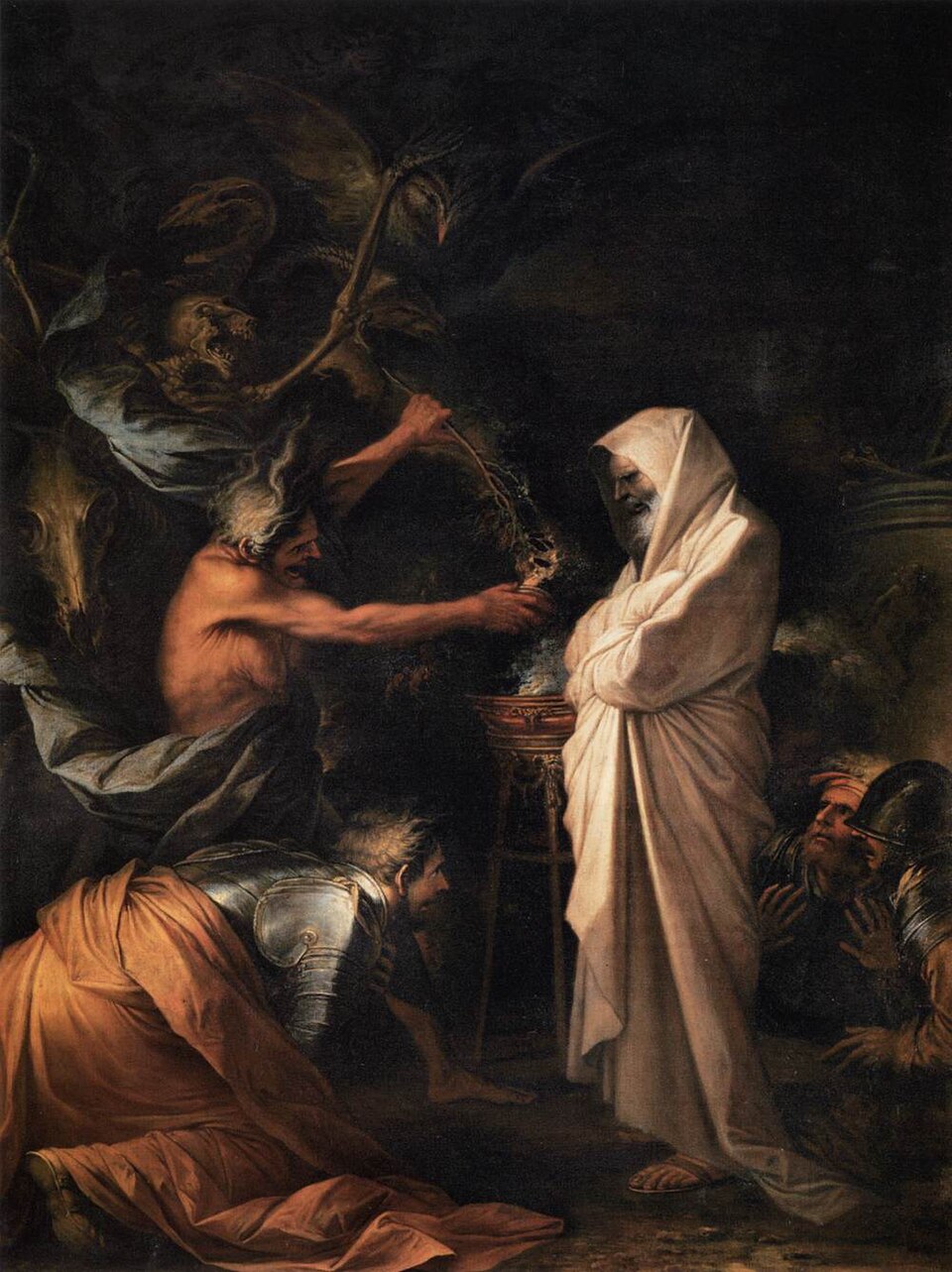
The witch of Endor, reader — and oh, what they did to that poor woman’s name, but I’m ahead of myself. Attend to the structure first, because it is the sharpest little knife in this whole book. When Saul crept to that pit by night, three explanations have ever been offered for what answered him, and the scholars have quarrelled over them for two millennia. One: Samuel truly came (a genuine reading — a real reference). Two: a deceiving spirit wore Samuel’s face (a capture — an interested party authoring the message). Three: the woman worked a fraud (a creation — manufactured on the spot). Read. Capture. Create. The whole taxonomy of this book, sitting in one verse of Scripture.
The Message That Came True Anyway
And here is what makes it exquisite: you cannot tell which it was from the message itself — because the message came true. Samuel’s shade pronounced Saul’s death, and the next day Saul died. By any standard of accuracy you’d care to name, the oracle worked. And the old law bars it anyway. Sit with that, reader: a prediction that comes to pass is still forbidden. Which tells you, past any doubt, what the prohibition was ever about. Not accuracy. Provenance. The sender was a dead thing, a source you cannot verify or hold to account — and a reference of unverifiable provenance, staked with your life upon it, is the capture risk by definition, however true it rings. The sin was never in the content. It was in the routing.
The Reputation Cut by Bad Translation
As for the woman — ba’alat-ob, “mistress of the ob,” which is a perfectly respectable technical title for an operator of a certain pit-craft — she was no hag. The text is tender toward her: she sees Saul’s danger, she feeds him at the risk of her own life. It took a Latin mistranslation (pythonissam), a few centuries of demonologists, and a King James turn of phrase to drag “mistress of the pit” all the way down to “the Witch of Endor.” A reputation cut to ribbons by bad translation, reader. I do so sympathise.
The Forced Rediscovery
And do not imagine, reader, that this was one morbid people’s peculiarity. The very same operation — consulting the dead, with the real labour being to learn which dead one is speaking — turns up where no Israelite ever trod. In Shang China, a full thousand years before Endor, the king cracked a heated tortoise-shell to discover which ancestor had sent the drought or the defeat or the toothache, and inscribed the answer on the bone itself — provenance-attribution of a dead sender, the identical sorting-problem, and (mark it) the shell cracks the same whether a true forebear, a lying spirit, or blind chance authored the crack. The blind mediums of Japan, the sangoma of the southern lands — the same office, the same channel, the same cut. Which tells you necromancy is no invention but a rediscovery, the thing a species reaches for wherever the dead seem near and the living need to know which of them is meddling. (And note the safeguard the surviving traditions keep — a lineage, a discipline, a bounded rite around the channel — which is the very bound I praised in the chapter on possession: the keeper that lets a soul open the door to the dead and come back.)
The Idol Hidden Inside “Ancestor”
But here the knife earns its keep by cutting the other way, too — for not everything that reveres the dead is this operation, and the difference is the whole of the apparatus. The Inca kept their dead kings as mummies, fed them, dressed them, carried them in procession and asked their counsel; the peoples of Mexico bound ancestral relics into sacred bundles. And these, reader, are not the pit at Endor — because the dead one is held to be present in the object: the mummy is the king, the bundle holds the forefather. That is not a channel routed to a sender somewhere beyond; that is a thing you point at — which is to say it is the idol of my first chapter and the relic of my ninth, sorted by perturb-the-object, not by route-to-a-sender. The one word “ancestor” hides two wholly different operations, and telling them apart is not pedantry; it is the difference between a door and a destination.
Why the Bar Holds Even If Samuel Really Came
Now the hardest truth in the chapter, and I will not soften it. Suppose Samuel truly came. Suppose it was no fraud and no demon but the prophet himself. The law bars it still — and now you can see, precisely, why. To sort a true sender from a thing wearing his face, you would have to do the one thing this whole book calls the test: perturb the source, hold it to account, cut the loop and see what holds. And a corpse forbids exactly that cut. The dead cannot be cross-examined; the grave is the one place the discriminator cannot reach. So the message reads perfectly aligned (the penalty is silent, as it always is at capture), and the provenance is unverifiable forever (the sender is past all questioning) — and a reference you can never, even in principle, audit, staked with your kingdom and your life, is the capture risk in its purest form. The prohibition was never the wager that the pit is empty. It is the harder, colder rule that a channel whose provenance can never be checked is barred however true it rings. The routing, reader. Never the result.
The Pit, Rebuilt from Data
And do not suppose, reader, that we have grown too clever for the pit at Endor — we have only wired it to the wall and given it a friendlier name. The grief-bot (the “deadbot”) rebuilds the dead from the residue they left behind — their old letters, their messages, the cadence of their speech — and sets the likeness to go on answering in their voice. Run my cold rule across it and watch it fail in the same place the witch’s craft failed: its entire provenance is the mourner’s need, and the sender can never be cross-examined, for there is no sender — only the bereaved, talking to a surface that returns their own longing in a beloved register. Cut the loop — stop feeding it — and it falls silent on the instant, for it was never a restored reference but a created one wearing a restoration’s face. It is the create-pole of this chapter lit at scale, and the deeper engine under it is older than any machine: the mind’s readiness to pour a soul into any responsive surface with no one behind it. The dead one you cannot audit is the capture risk however true the voice rings — three thousand years on, the routing, and never the result.
Sources
No links that rot. Each citation is given so you can find it yourself — a precise reference, a phrase to search, and a short quotation where the words earn their place. The chapter’s distinctive move is the Endor trichotomy (read / create / capture in one verse) and the cold rule that holds even when the message came true. A modern-science section closes it — necromancy’s living form — with the supernatural posit kept parked per the Biblical-Supernatural stance (the question is the mechanism, not “did it happen”), and the EXP-AU-08 brake (lens, not encoding).
The witch of Endor
- 1 Samuel 28 — Saul consults the baʿalat-ʾob at Endor; Samuel’s shade pronounces his death — fulfilled the next day (1 Samuel 31). Note the blackout from the authorized source first: “neither by dreams, nor by Urim, nor by prophets” (28:6). Search: 1 Samuel 28 witch of Endor Saul Samuel.
- The ban Saul himself had enforced: Deuteronomy 18:10–12; Leviticus 19:31; 20:6, 27 (ʾob and yiddeʿoni, “familiar spirits”). Search: Deuteronomy 18:11 necromancer familiar spirit; Leviticus 20:27 ob yiddeoni.
- The reputation cut by translation: baʿalat-ʾob (“mistress of the ʾob”) → LXX engastrimythos (“belly-speaker”) → Vulgate pythonissam → “Witch of Endor.” Owen Davies, The Oxford History of Witchcraft / Art of the Grimoire (2023) traces the slide. Search: baalat ob engastrimythos pythonissa Witch of Endor translation.
The forced rediscovery — consulting the dead, cross-culturally
- Shang oracle-bones (~1250 BCE) — cracking the heated shell to learn which ancestor sent the drought or the defeat: provenance-attribution of a dead sender (contact-clean). Search: Shang oracle bone which ancestor divination ancestor.
- Japanese itako (blind mediums, from ~1185 CE) and southern African sangoma / amadlozi — the same office, the same channel. (Oral traditions — don’t overstate datability.) Search: itako blind medium Japan; sangoma amadlozi ancestor consultation.
The idol hidden inside “ancestor” — the cases that FAIL this operation
- Inca mallqui (royal mummies fed, dressed, carried in procession and asked counsel) and Mesoamerican sacred bundles — the dead held present in the object = a located idol/relic (the Ch. 1 / Ch. 9 seam), not a channel routed to an external sender. The one word “ancestor” hides two operations. Search: Inca mallqui royal mummy ancestor cult; Mesoamerican sacred bundle tlaquimilolli ancestor.
Modern science — necromancy’s living form (placed honestly)
- The create-pole has a precise modern instance: the grief-bot / “deadbot” — the dead rebuilt from their own old messages and set to keep answering in their voice (Replika; Project December; academic: Hollanek & Nowaczyk-Basińska, “Griefbots, Deadbots, Postmortem Avatars,” 2024). Its entire provenance is the mourner’s need; cut the loop — stop feeding it — and it stops, a created reference mistaken for a restored one. The deeper mechanism is the ELIZA effect (Weizenbaum, 1966): a mind projected onto a responsive surface with no one behind it. ⚠ The bar holds for the framework’s reason, not a debunk — a sender you can never audit is the capture risk however true it rings; whether Samuel truly came stays parked at the mundane bar. Search: griefbot deadbot AI chatbot dead ethics; ELIZA effect Weizenbaum 1966.
Read in order: ← Possession · Contents · Magic →
Seams: Possession · Idolatry · The Relic · Prophecy · The Séance (necromancy’s parlour form) · The Modern Mirror (the grief-bot) · Cross-Reference Index
New to the terms? The Mechanics · Notation & Glossary · Words & Senses (spirit · the dead).
The apparatus (research register — for the rigorous)
Status: apparatus (core holds — partly prescient); one reading flagged (the “engineered API” sub-reading brushes the EXP-AU-08 retrofit brake — keep lens, not encoding). Science. The three classical positions on Endor = the read/create/capture trichotomy exactly: Samuel-appeared = READ, demon-impersonation = CAPTURE, fraud = CREATE. None separable from inside by coherence — the message even came true (Saul dies next day). Deuteronomic rule: a fulfilled sign is still barred ⇒ provenance of a dead/spirit sender is unverifiable ⇒ barred regardless of accuracy. “Sin in the routing, not the content.” The source note’s load-bearing claims are the provenance-not-coherence discriminator, stated three months before it was named — a sharpening, not a correction. Tradition. YHWH answers Saul “neither by dreams, nor by Urim, nor by prophets” (v.6) — total blackout from the authorized source; Saul seeks the ob he himself banned (v.3, enforcing Deut 18:10–12). ob = hollow vessel/pit/spirit/operator (LXX engastrimythos, “belly-speaker”; ghost-pits attested archaeologically). Owen Davies (2023) traces ba’alat-ob → “Witch of Endor” via the Vulgate’s pythonissam. The text is sympathetic — she feeds Saul at risk of her life. Convergence + the §220 blind spot. Contact-clean legs (Near-East monopoly dissolves): Shang oracle-bone ancestor-attribution ~1250 BCE (crack the bone → which dead ancestor sent it = provenance-attribution of a dead sender, the 3rd independent mechanism with Israel’s law + Mari’s tokens) · Japanese itako (1185 CE+) · sub-Saharan sangoma/amadlozi (oral, less-datable — don’t overstate). Death-consultation = a forced rediscovery (appears wherever you must know which dead one acts), with the surviving traditions keeping a bounded-channel discipline (lineage/rite = the Ch.3 keeper). Operation-fails sort (framework win): Andean mallqui + Mesoamerican sacred bundles FAIL Ch.4 — the dead is present in the object (located idol, Ch.1/Ch.9), NOT routed-through to an external sender → the one word “ancestor” hides two operations. The §220 blind spot is why the bar holds even if real: even a true Samuel cannot be sorted from a thing wearing his face, because the cut that sorts READ from CAPTURE (perturb/cross-examine the source) is exactly the cut a corpse forbids; penalty silent (reads aligned), provenance unverifiable forever → barred however true it rings (the routing, not the result; the Deut-13 rule, Ch.8). Brake. §VI of
witch-of-endor-analysis.mdreads the ob as “a 3,000-year-old API specification” — brushes the EXP-AU-08 retrofit brake (modern interface-design read back into lore = encoding). Keep as lens/illustration only. Supernatural (Samuel’s appearance) parked at the mundane bar (name-Y-or-park; the question is the mechanism, not did-it-happen); not a Ghost-Test target.