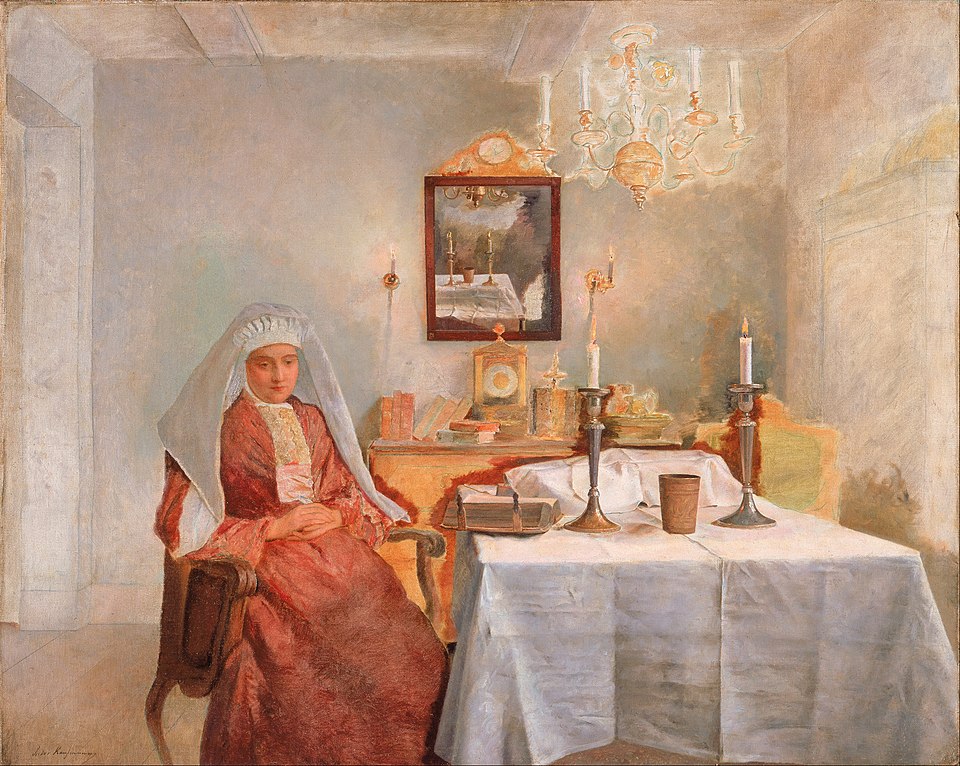
We have learned to draw the line in space, reader; now I must teach you to draw it in time — and it is a harder lesson, because a wall you can see and a feast-day you cannot, and yet of the two it is the unseen one that more men die without. For there is a kind of capture that needs no idol and no oracle and no spirit at the rim of any circle. It is the capture by the doing itself — the work that will not end, the market that never closes, the field worked until it is salt, the glowing glass that refreshes forever and is never, not once, finished. A loop does not need a face to eat you. It only needs to never stop. And so against the oldest tyranny of all — the tyranny of the ceaseless — a certain people set the strangest and most subversive institution in the whole history of the sacred, which was a commanded halt.
The Commanded Halt and Why It Works
Hear how it is grounded, reader, for the grounding is the whole genius of it. The fourth of the great commandments does not say rest because you are tired — fatigue would make the stopping a thing you negotiate, skippable on a strong day. It anchors the halt outside the worker entirely, and it does so twice over. Once in the deep past: the Maker Himself ceased on the seventh day, so that the one who stops is not indulging a weakness but imitating the floor of the world — the halt is woven into the structure of things, not into your mood. And once in the raw memory of bondage: remember that you were a slave in Egypt — therefore you shall stop, and your son shall stop, and your servant, and the foreigner inside your gates, and even the ox. Mark what that does. It defines the halt as the very signature of a free person — for the thing a slave precisely cannot do is stop; the slave is worked at another’s will without ceasing, and so a people just dragged out of the brick-pits are handed, as the first mark of their freedom, the right and the duty to lay the work down. The Sabbath is the anti-Pharaoh built into the week. And here it meets the spine of my whole book head-on: the one who cannot cease is, by this ancient and exact definition, not free — he is owned, whatever he calls his owner. To stop is to prove you have a ground that is not the work; to be unable to stop is to confess you have none.
The Bound in Time, and the Test
For that, reader, is what sacred time is, once you strip the candles away — the bound of this whole book, drawn not around a place but around an interval. Everything I have told you of the third point that stops the loop from eating its own tail: a Sabbath is exactly that, set in the calendar and made to recur whether you consent or not. The doing — work, gain, the optimising of the self, the endless scroll — is a thing that, left unbounded, runs away: it feeds on itself, it expands to fill every hour you will give it, it becomes a reference that answers only to itself, which you will recognise, because I have spent a whole book on it, as the runaway with no outside. The fixed halt is the periodic cut driven straight through it. And — this is the part that should make you sit up — the cut is also the test. Can you stop? Install the halt and lay the doing down, and watch what happens to you in the silence. If your worth, your name, your very ground is still there when the work is set aside, then the work was something you did, held at arm’s length, a thing with a real outside — you were grounded, and the Sabbath only confirmed it. But if laying it down brings dread, withdrawal, a frantic reaching for the glass — if you cannot stop — then the doing had become your Y, you had no reference but the loop, and the rest you cannot take is the alarm you cannot hear by any other means. The Sabbath is cut-the-loop performed on your own life, once a week, in the body.
Jubilee and the Economic Runaway
And the people who kept it did not stop at the week. They drew the same line across the years. Every seventh year the land itself was to lie fallow — no sowing, no reaping, the soil released from the relentless extraction; and every seventh seven, the fiftieth year, came the thing they called Jubilee, and it is the most astonishing economic instrument ever merely imagined: debts forgiven, bond-servants freed, and the land returned to the families who had lost it. Look at the mechanism, reader, with the eyes this book has given you. Wealth and debt, left unbounded, compound — they are a runaway too, a Fisher-loop in money, the holdings of the few swelling and the debts of the many deepening, generation upon generation, with nothing in the arithmetic itself to ever stop it, until a handful own everything and the rest own nothing and are themselves owned. The Jubilee is a forced external reset dropped into that runaway on a fixed clock — not earned, not negotiated, not triggered by anyone’s mercy in the moment, but scheduled, beyond the reach of the winners who would surely never call it themselves. It is the Sabbath’s own logic — the commanded halt that breaks the loop that cannot break itself — scaled from the week to the lifetime. (And I will be honest, as ever: the scholars argue whether the Jubilee was ever fully kept, and it may have lived more as a commanded ideal than a practised year. It does not weaken the point in the least, for the point is the mechanism, and the mechanism is sound whether or not a hard-hearted age obeyed it — as our own age, with every tool to, does not.)
The Genus Is Everywhere
Now let me set the honest breadth around it, reader, for I will not have you think one tribe invented the holy day — the genus is everywhere. Nearly every people that ever kept a calendar bounded its time: the fixed feast that stops the ordinary world, the lunar observance-days of the Buddhist uposatha on which the layman takes on the stricter precepts, the days of ritual abstinence a Chinese officiant kept before he dared approach the sacrifice, the Roman calendar that marked which days business might and might not be transacted, the fallow field rested the world over by farmers who had simply learned that land worked without ceasing dies. The interrupted loop, the periodic stop, is a near-universal rediscovery, and I count it as one — the wall in time is raised by many hands. But I will also tell you, with the same honesty I spend on everything, what in this particular tradition stands out and is not universal: not the holy day as such, but this holy day — the weekly stop, recurring far faster than any moon or season, owed to everyone down to the slave and the ox and the stranger, and grounded explicitly in liberation rather than in placating a power or purifying for a rite. A feast that purifies the priest for the altar is one thing; a weekly civil right to cease, extended to the lowest person in the household and justified by the memory of slavery, is a sharper and rarer thing, and I will neither inflate the genus into a boast nor shrink the distinctive species out of false modesty. The stop is everywhere; the stop as the emblem and guarantee of a common freedom is comparatively the property of few.
When the Halt Becomes the Cage
And the same two faces, reader — you are waiting for them now, and you are right to. The bound in time can be the freeing halt, or it can curdle into a new tyranny, a cage of obligatory days multiplied by an interested priesthood until the rest meant to liberate has become one more master to fear. And mark who says so most sharply: the tradition itself, auditing its own institution from the inside. When the keeping of the day had hardened in some hands into a thing that bound men rather than freed them, a teacher of that very people cut clean to the mechanism — the Sabbath was made for man, and not man for the Sabbath. That is this whole chapter’s discriminator spoken two thousand years early: the halt is read and good when it serves the freeing of the one who keeps it, and it has been captured — turned from a door into a Pharaoh — the moment it exists to serve the keepers of the rule instead. The bound is never holy for being a bound. It is holy only when the thing it frees you for is real.
Secular Is Not Safe
And so to your own century, reader, which abolished the Sabbath and called the abolition freedom — and you of all generations should feel the irony in your own thumbs. We tore down the commanded halt; we built the world that never closes, the market that trades through the night, the work that follows you home in your pocket, the feed engineered with a precision no Pharaoh ever had to refresh forever and never let you finish; and we called this liberation, this being available at all hours to every demand, and by the Sabbath’s own ancient and exact definition we walked ourselves straight back into Egypt, for the one who cannot stop is a slave and we have built a machine to make sure none of us can. But mark, too — and this is the third register, the secular one, doing the thing it always does — that the abolished bound comes back, reinvented by hands that have forgotten where they first learned it, because the runaway it answered is real and will not be wished away. The labour movement, fighting the industrial loop that worked men to death, did not invent a new idea; it re-derived the Sabbath and called it the weekend — eight hours for work, eight for rest, eight for what we will — the fixed external halt wrenched back from the production-engine by people who would have been startled to be told they were keeping a commandment. The financial engineers, watching their markets fall into self-amplifying crashes, built the circuit-breaker — a forced, scheduled, non-negotiable halt that trips and stops all trading when the feedback runs away — which is the Jubilee shrunk to fifteen minutes, the commanded stop dropped into a loop that cannot stop itself, re-invented from scratch at a trading desk. And now, latest and most telling, the people captured by the glowing glass reach for the “digital sabbath,” the detox, the day logged off — groping back, often without a scrap of the old vocabulary, toward the one architecture that ever worked against a loop that will not end: stop, on a fixed clock, whether or not you feel you can. Temple and picket-line and trading-floor and the lonely soul deleting the app at midnight — all reaching for the same halt, because the ceaseless is the ceaseless in every age, and there has only ever been the one answer to it. (Though here the sting bites as it always does: the secular halt is not safe for being secular. A “self-care” rest that is itself optimised, performed for an audience, posted — rest turned into one more thing to produce — is the bound captured, the Sabbath folded back into the very loop it was meant to cut; and a detox-retreat sold to you at a premium is only the priesthood multiplying holy days for profit, in a yoga mat instead of a mitre. The halt frees you only when you are not still, in the resting, working.)
So here is the test, reader, and you can run it this very week without my leave or anyone’s. Choose a stop — an hour, an evening, a day — fixed in advance, owed to nothing, and take it; lay the doing down where you cannot reach it. And then attend, with the honesty this book has tried to teach you, to what stands and what falls in the silence. If you find, under the work, a ground that was there all along — a self, a tie, a reference that the doing served and did not constitute — then keep the doing, for it was yours; you were free in it. But if you find that you cannot take the stop, that the silence is unbearable, that some part of you is already reaching back toward the loop before the hour is out — then you have found, by the one test that cannot be fooled from the inside, the thing that owns you. And the finding is not a defeat, reader. It is the alarm finally sounding. The commanded halt was never the prison your tired century took it for; it was, and is, the proof and the practice of the one freedom no slave has and no free soul surrenders — the freedom, on a fixed day, against every urgent reason, simply to stop.
Sources
No links that rot. Each citation is given so you can find it yourself — a precise reference, a phrase to search, and a short quotation where the words earn their place. The chapter owns a distinctive species (the weekly liberation-rest owed to everyone) inside a near-universal genus (periodic sacred time) — and states both, inflating neither. A modern-science section closes it: the loop that won’t end, and the halt re-invented. Brakes: lens not encoding (EXP-AU-08); the Babylonian precedent is contested — bank nothing.
The commanded halt
- Genesis 2:2–3 (the Maker ceases — imitatio Dei, the halt woven into the world’s floor); Exodus 20:8–11 (the Decalogue command, creation rationale); Deuteronomy 5:12–15 (the liberation rationale — “remember that thou wast a servant… therefore” — extended to servant, stranger, and ox). Search: Exodus 20:8 remember the sabbath day; Deuteronomy 5:15 remember you were a slave in Egypt sabbath.
- The tradition’s own self-audit: Mark 2:27 — “the sabbath was made for man, and not man for the sabbath.” Search: Mark 2:27 sabbath made for man.
The years — fallow and Jubilee
- Leviticus 25 — the sabbatical year (the land fallow every seventh) and the Jubilee (the fiftieth: debt-release, manumission, land-return). ⚠ Whether ever fully practised is debated; the claim is the mechanism. Search: Leviticus 25 sabbatical year Jubilee land fallow debt release.
The genus — periodic sacred time (near-universal, counted once)
- Buddhist uposatha (lunar observance days, stricter precepts); Hindu ekadashi; Chinese ritual abstinence (zhai) before sacrifice; Roman dies fasti / nefasti and the nundinae market-cycle; the agricultural fallow worldwide. Search: uposatha Buddhist observance day; Roman dies fasti nefasti nundinae.
- ⚠ The Babylonian šapattu (full-moon day) / “evil days” as an origin for the Sabbath is contested — note it, derive nothing; the weekly fixed cycle owed to all is the distinctive thing. Search: shapattu Babylonian sabbath origin debate.
Modern science — the loop that won’t end, and the halt re-invented (placed honestly)
- The “cannot stop” — the feed “engineered to refresh forever and never finish” — is persuasive design / behavioral addiction: variable-ratio reinforcement (B. F. Skinner), the attention economy and “hooked” product design (Nir Eyal; Tristan Harris / Center for Humane Technology), and infinite scroll (Aza Raskin, who built it and regrets it). The Sabbath’s discriminator — can you stop? — is the clinical question of compulsion. Search: variable ratio reinforcement Skinner; persuasive design attention economy Tristan Harris infinite scroll Raskin.
- The forced halt, re-invented without the vocabulary: the weekend / eight-hour day (the labour movement), the market circuit-breaker (SEC Rule 80B — the Jubilee at fifteen minutes), the “digital sabbath” / detox. ⚠ Secular-not-safe: an optimised, performed “self-care” rest is the bound folded back into the loop; the premium detox-retreat is the priesthood multiplying holy days for profit. The mechanism is an off-switch for a runaway; the tradition is the explanandum, not an encoder of the dynamics. Search: eight-hour day weekend labor movement history; digital sabbath detox.
Read in order: ← The Wall · Contents · The Canon →
Seams: The Wall · The Mysteries · Possession · The Modern Mirror (the feed that never finishes; the digital sabbath) · Cross-Reference Index
New to the terms? The Mechanics · Notation & Glossary.
The apparatus (research register — for the rigorous)
Status: candidate — Y-operation named (sacred time = the bound in time: a fixed, externally-grounded, recurring cessation that breaks the unbounded doing-loop and tests whether the agent’s Y survives the stop). Runnable discriminator (can you stop?). Twin-signed (the freeing halt vs the captured cage). Second member of the bounds triad (space/Ch.14 · time/this · word/Canon). Science. The unbounded doing (work / gain / self-optimization / attention-capture) is a two-point runaway: with no external stop it feeds on itself, expands to fill all available time, and becomes a reference answering only to itself (Y collapses onto the activity M; Fisher-runaway, the Part-3 §4 four-eras object in the time domain). A sabbath = a periodic cut driven through the loop on a fixed external clock — and the cut doubles as the test: lay the doing down and observe whether the agent’s ground (worth/identity/Y) survives the cessation (READ — the work was held, grounded outside it) or collapses into dread/compulsion/withdrawal (CREATE/capture — the loop had become the only Y; “cannot stop” = possession in the time domain, the Ch.3 blind spot run on a clock). Free-will (§1.6): the move protected in time (pre-commit a recurring stop, locked past the future self who will always have an urgent reason to skip it — Ulysses-at-the-mast in the calendar) AND the very emblem of free will (the slave cannot cease; the capacity to stop = proof of a Y outside the loop). Jubilee: the same forced-external-reset applied to the economic runaway (debt/wealth compounding with no internal stop) on a fixed clock beyond the winners’ reach. Tradition. Hebrew Sabbath (BCE, pre-exilic institution): Gen 2:2–3 (the Maker ceases — imitatio Dei, the halt woven into the world’s floor, not into mood); Exod 20:8–11 (the Decalogue command, creation rationale); Deut 5:12–15 (the liberation rationale — “remember you were a slave… therefore” — the halt as the signature of a free person, extended to servant/stranger/ox) = the load-bearing free-will anchor. Sabbatical year (Lev 25:1–7, land fallow every 7th) + Jubilee (Lev 25:8–55, the 50th: debt-release, manumission, land-return = the scheduled reset breaking the economic runaway). The tradition’s own self-audit: “the Sabbath was made for man, not man for the Sabbath” (Mark 2:27, CE) = the discriminator stated from inside (the bound is read iff it serves the freeing; captured the moment it serves the keepers of the rule). Genus (honest breadth, periodic sacred time = near-universal, count as one): Buddhist uposatha (lunar observance days, stricter precepts); Hindu ekadashi / fixed ritual calendar; Chinese ritual abstinence (zhai) before sacrifice; Roman dies fasti/nefasti + nundinae (market-cycle rest); the cross-cultural agricultural fallow (the Jubilee’s mundane cousin); indigenous seasonal ceremonial cycles. Distinctive species (own it, like resurrection — distinctive-not-universal): the weekly stop (far faster than moon/season), owed to everyone (slave/stranger/animal), grounded in liberation rather than placation/purification. Preserved-Y seam: portable sacred time — the calendar a people carried through exile (the Sabbath needs no temple, no land, no object → unconfiscatable; the bound that survived the Diaspora). Brake. (1) Lens, not encoding (EXP-AU-08) — describable as an off-switch for a Fisher-runaway; do NOT claim the tradition “encoded” runaway dynamics. (2) Babylonian precedent CONTESTED — do not bank — the šapattu (15th day / full moon) and the “evil days” are sometimes linked to the Sabbath’s origin/etymology; the link is debated and the weekly fixed cycle is the distinctive thing — note honestly, derive nothing from it. (3) Distinctiveness owned, not inflated — periodic sacred time is universal (genus); the weekly-liberation-rest-for-all is comparatively distinctive (species); state both, inflate neither (the anti-partisan discipline — same as resurrection). (4) Jubilee implementation debated — may have been a commanded ideal more than a practised year (scholars differ); the mechanism (scheduled external reset of a compounding runaway) is the claim, sound regardless of enforcement history. (5) Both-sided / secular-not-safe — the bound curdles into legalism/control (the captured cage — the tradition itself flags it, Mark 2:27); the secular age abolished the halt and rebuilt slavery (24/7/always-on = “cannot stop” = Egypt by the Sabbath’s own definition); secular re-inventions are convergence, not a confirmation count (weekend/labour-movement, market circuit-breaker = Jubilee-in-miniature, digital-sabbath/detox) AND not-safe (optimised/performed “self-care” rest = the bound folded back into the loop; the premium detox-retreat = priesthood multiplying holy days for profit). (6) Dating honest — Sabbath BCE (pre-exilic); Mark 2:27 CE; uposatha/Roman/Chinese genus dated to their own strata. Seams: ↔ Ch.14 (barrier, space) + Canon (word) = the bounds triad; ↔ Ch.11 (the bound = the third point); ↔ Ch.3 (cannot-stop = possessed in time; the blind spot on a clock); ↔ Part 3 §4 (the runaway’s missing off-switch); ↔ the diaspora preserved-Y (portable sacred time); ↔ §1.6 (the protected move + the emblem of the one free move).