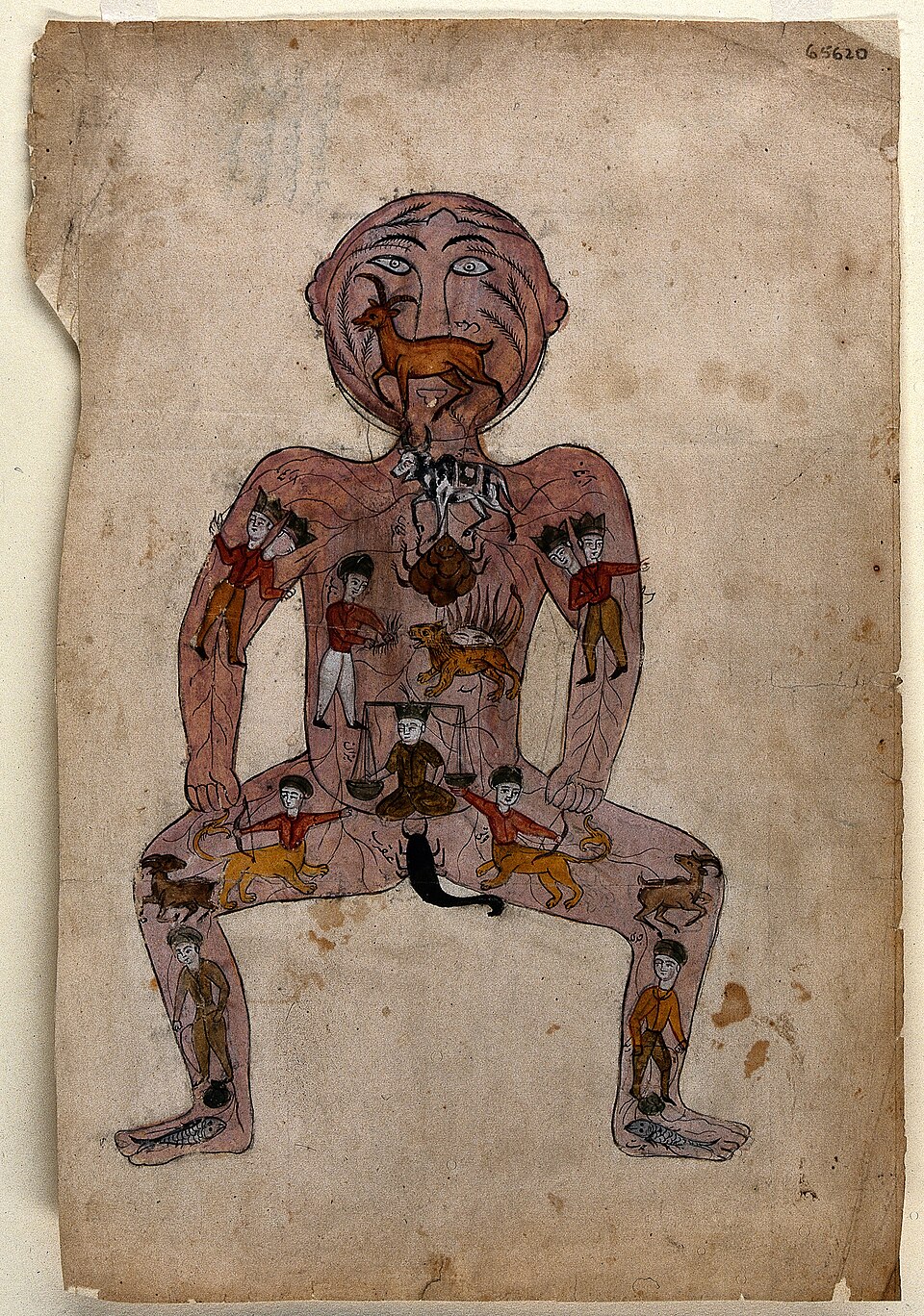
Consider, reader, the diviner bent over a sheep’s liver, and beside him a physician bent over a thermometer. I will tell you a thing that should unsettle you: the gesture is identical. Each takes a physical object — a liver, a column of mercury — and reads it as a readout of some hidden order he cannot see directly. The entire, the only, difference between the omen and the instrument is a single question, and it is not a question of dignity or science or sophistication. It is: is the thing you are reading actually coupled to the thing you are asking about? The mercury rises with the fever it reports. Does the liver rise with the war it foretells? That untested coupling is the whole of it — and the omen-readers, three thousand years of them, never once checked.
The Mirror That Shifts With You
How would you check? Cut the loop, as ever. Change the reader, change the rite, change what counts as confirmation. A true reading — one coupled to an external order — holds across all that. A mirror shifts with the reader, because the only order it ever tracked was the reader’s own projection, read back out of the entrails like a face found in a cloud. The diviner, reading himself, and calling it the gods.
The Omen That Actually Couples
But — and here I credit a sharper eye than my own — not all omenry is empty mirror, and the exception is precise and rather beautiful. An augury that tells a host when to march, who strikes first genuinely works — not because the liver knows the battle, but because it is a shared signal that makes a thousand soldiers move as one. It couples through coordination, not through prophecy. Which yields a clean, falsifiable line: omens should work for problems of coordination and fail for questions of bare nature — they can tell you when to attack and never whether it will rain. And where someone finally did check the coupling, the practice grew up and changed its name: astrology became astronomy, alchemy became chemistry. The discriminator firing, once, in the open record of history.
One Surface, Two Readings
I said once. I understated, reader, and I will not let the understatement stand, for it is the whole reason I have given astrology a chapter of its own. The test did not fire once. It fired again and again, in cultures that never met — and the sky is where you may watch it happen, because the sky is the single surface men read in two ways at the same time. One reading was coupled to something real and grew into a science; the other was a mirror and stayed astrology; and the marvel is that both readings were taken off the very same stars. Watch. In Babylon they kept a tablet — we call it the Venus Tablet of Ammiṣaduqa, and it is near thirty-six centuries old — and on that one slab of clay sit, side by side, the omens (if the star of the woman stands thus, the king shall…) and one-and-twenty years of patient record of exactly when Venus rose and set. The superstition and the data, in one hand, on one tablet. From the data came astronomy good enough to land the planets’ periods to four decimal places; from the omens came nothing that survived a checking. The surface split, and the tablet caught it splitting.
And Egypt — Egypt found the one star-omen that was true, and it was true for the most unromantic reason imaginable: it coupled. Four thousand years ago they painted columns of stars inside their coffin-lids, six-and-thirty little gods of the decans rising each in their ten-day turn to tell the hours of the night; and chief among them Sopdet, whom the Greeks called Sirius, who vanished from the sky for seventy days and then rose again just before dawn in the height of summer — and her rising foretold the flooding of the Nile. And it foretold it correctly, every year, for three thousand years. Was she a goddess speaking? She was a clock. Sirius and the flood did not whisper to one another; they were both children of the same solar year, and so the one kept time with the other. That is a coupled omen — and you must hold the lesson very firmly, reader, for it cuts the wrong way for the credulous: the star-reading that worked did not vindicate the star-readings that didn’t. It convicted them. The test that crowned Sirius is the very same test that exposed the horoscope, and a thing that cannot survive that test is not made respectable by standing next to a thing that can. (And lest you think this an old-world quirk — across an ocean no Babylonian ever crossed, the Maya reckoned the dance of that same Venus to within a hair of her true period, and also read her risings as the hour to make war. The split surface, found again, contact-clean.)
The Same Split, on Silicon
And the split surface has a newest face, reader, the one the young now read by the million: they feed their birth-hour and their troubles to a machine and ask it to cast the chart, read the cards, say what the stars intend. Bring the same knife. A model can be coupled — a forecast that tracks a real order, that holds when you change who asks and how, the way a weather-engine reads the actual sky — and that is the astronomer’s reading wearing this century’s coat. But the AI horoscope, the chatbot tarot, the “what do my stars say of my heart” — perturb it and watch: rephrase the question and the destiny shifts, flatter it and it warms, and the only order it ever tracked was your own, read back out of the silicon like a face found in a cloud. It is the diviner reading himself, mechanized — and worse than the liver in one exact respect, for the old rod at least could go still: the dowser’s twig fell quiet where there was no water, but the machine can never return no answer, it is built to produce a fluent reading from whatever you bring, so it is a mirror that cannot even fail honestly. The cut is the one this chapter has run all along: keep the reading that survives the loosening of who-asks. Placement, not prophecy: the young rediscovered the natal chart in a chat-window; the chapter only names which of its two readings they are taking.
What This Chapter Will Not Claim
I will confess two reaches, because this chapter tempts me to overstate and I would rather you caught me than the critics. The first: when the priesthoods drew their lines between the sanctioned omen and the forbidden one, I should love to tell you they were sorting the coupled from the mirror — but honesty forbids it, for a guild that licenses only its own members and condemns the freelancer is doing something far more ordinary than epistemology, and I cannot prove it was ever more than a monopoly defending its franchise. And the second: that a real fate, a true order behind the stars, does not exist — this I do not claim either; I park it, at the same bar as the cloud-face, neither asserting nor dismissing. What I claim is only the cut: read your surface two ways, and keep the reading that survives the loosening of who-asks and how. Be the astronomer at the coffin-lid, not the astrologer at the natal chart — even when, especially when, the two of them are reading the very same sky.
The Alchemist, the Lot-Caster, and the Dowser
For there is a cousin of the star-reader I must seat at this table too: the alchemist, who did upon matter exactly what the astrologer did upon the heavens — read a crucible of reactions as a readout of the soul’s perfection. And the same knife fell: where the reactions coupled to the stuff he could check his work, and his art became chemistry; where they coupled only to his longing, it stayed gold-dreaming. And the lot-caster, shaking his stones — him I half-acquit, for a lot honestly cast and publicly honoured is the coordination-omen in its purest form: it does not know the answer, but it makes a divided house choose one, and that is a true and useful thing. Israel kept two such stones in the high priest’s breastplate, the Urim and the Thummim, and cast them for a plain yes or no near three thousand years ago — and mark why a fair lot cannot lie: it rests at the exact balance-point where no thumb can be proved to have pressed, the one reading on earth that cannot be rigged, which is the whole of its honesty and the whole of its use. And the dowser with his twitching rod, walking the field for water — there is your mirror still living among us: blind him to where the pipe runs and the rod goes still, for it was never the water that moved it but his own hand, trembling out the answer he already carried. And watch what his guild does when the rod is shown to fail — the conditions were wrong, a doubter spoiled the field, the gift comes and goes — which is the poison-chicken’s excuse exactly, the serpent’s tail back in its mouth, only now wearing a laboratory coat. The reader, reading himself, and calling it the stars. It is the oldest story in this book, and I will tell it once more before the end.
Sources
No links that rot. Each citation is given so you can find it yourself — a precise reference, a phrase to search, and a short quotation where the words earn their place. This chapter’s distinctive move is catching the discriminator firing in the record: one surface read two ways. A modern-science section closes it — the mirror, measured — with the brake that this separates astrology from astronomy, it does not validate astrology, and a real “fate” stays parked at the same bar as a cloud-face (EXP-AU-08, strong form: killed).
One surface, two readings — the split caught in the record
- The Venus Tablet of Ammiṣaduqa — Enūma Anu Enlil tablet 63, ~17th c. BCE: omens and 21 years of Venus risings/settings on one slab; the data became astronomy, the omens survived no check. See Venus Tablet. Search: Venus Tablet Ammisaduqa Enuma Anu Enlil.
- Enūma Anu Enlil (~7,000 celestial omens) and MUL.APIN (~1000 BCE) — the sky read as a tablet the gods wrote on. ⚠ Exact omen wording: verify before quoting (Reiner–Pingree). Search: Enuma Anu Enlil celestial omens MUL.APIN.
- Egyptian decan star-clocks (coffin lids, ~2100–1800 BCE) and the heliacal rising of Sirius (Sopdet/Sothis) foretelling the Nile flood — the omen that worked because it coupled (both children of the solar year). Search: Egyptian decans Sirius Sothic rising Nile inundation.
- Maya Venus (Dresden Codex; synodic period reckoned at 583.92 days) — also read as the hour to make war: the split surface found again, contact-clean (codices dated CE, the system older). Search: Maya Venus Dresden Codex 583.92 war.
- Ptolemy — Tetrabiblos (astrology) beside the Almagest (astronomy): the two readings in one hand. Search: Ptolemy Tetrabiblos Almagest astrology astronomy.
Lots and the dowser — coordination vs mirror
- Urim & Thummim — the high-priestly yes/no lot (Exodus 28:30; cast in 1 Samuel 14 and Joshua 7’s binary-search on Achan); Proverbs 16:33 (“the lot is cast into the lap, but the whole disposing thereof is of the LORD”). The fair lot at the θ=½ balance-point = the un-riggable Schelling randomizer (a coordination-Y, not a truth-oracle). Search: Urim and Thummim lot Proverbs 16:33; Achan lot Joshua 7.
- Dowsing — the ideomotor effect (W. B. Carpenter, 1852: subliminal expectation amplified by the rod); the Munich / GWUP double-blind barn trials and Enright’s reanalysis (the effect vanishes under standard stats); Randi’s pipe tests (chance). Search: dowsing ideomotor effect Carpenter; Munich dowsing trials Enright reanalysis.
Modern science — the mirror, measured (the obvious links, placed honestly)
- The “reader who reads himself” is the Barnum / Forer effect (Forer, “The Fallacy of Personal Validation,” 1949 — vague readings felt as personally true) and apophenia / pareidolia (the face found in a cloud the chapter names). Search: Forer Barnum effect personal validation; apophenia pareidolia pattern.
- The canonical empirical test: Shawn Carlson’s double-blind astrology test (Nature, 1985) — astrologers could not match natal charts to personality profiles above chance. Cut-the-loop, run in a lab. Search: Carlson 1985 double-blind astrology test Nature.
- Where the science lands, and where it doesn’t. It confirms the mirror (Carlson, Forer, ideomotor); the coupled readings (Sirius↔flood, the Venus period) are simply celestial mechanics — the solar year and orbital dynamics, not a vindication of astrology. The test separated the two; that separation is the lesson. ⚠ Whether a real order/“fate” stands behind the stars is parked at the same bar as the cloud-face — not asserted, not dismissed (name-Y-or-park; not a debunk-by-Forer). Astrology→astronomy and alchemy→chemistry are the demarcation firing in the open record.
Read in order: ← Dreams · Contents · Prophecy →
Seams: Divination · Dreams · Prophecy · The Modern Mirror (AI tarot/horoscope = the mirror on silicon) · Cross-Reference Index
New to the terms? The Mechanics · Notation & Glossary.
The apparatus (research register — for the rigorous)
Status: candidate (read-via-opaque-surface; coupling untested → mostly mirror). Astrology→astronomy = the discriminator firing once, historically. Science. Omen-reading = the read-Y operation on an opaque surface at the stochastic layer: a liver/birds/planetary configuration (M) read as a readout (D) of a hidden order (Y). Strip names =
I(D;M|Y)with Y unnamed and coupling untested. The missing coupling test = the entire omen/instrument difference (thermometer M=mercury vs entrails M=liver: identical gesture, only one coupled). Cut-the-loop: perturb reader/procedure/feedback; a READ omen survives (tracks external referent’s domain), a mirror tracks the reader’s projection (apophenia). Sharp prediction: augury that coordinates couples through a shared-Y Schelling signal — works for coordination problems, fails for pure-nature questions (falsifiable). Astrology→astronomy, alchemy→chemistry = the historical record of this discriminator firing. Dowsing — the awareness-asymmetry test actually run (owl-cat-corpus-rent-sort.md). Blinded for 170 yrs: Munich barn trials (~500 dowsers, >10⁴ double-blind) → Enright reanalysis (effect vanishes under standard stats); Randi pipe tests → chance. Mechanism named: the ideomotor effect (Carpenter 1852) — subliminal expectation amplified by the rod; blind the target → collapses to chance (a self-mirror that cannot return “no answer”). Don’t over-deflate — name the Y correctly: the field-vs-barn gap is often a real Y — the experienced driller reads terrain (drainage/vegetation/topography) subliminally and the rod externalizes it — misattributed to water+twig. Contrast Urim/Thummim, which can return no-answer (autonomous Y); the rod cannot. Lots / Urim & Thummim — Claim A vs Claim B (owl-cat-corpus-rent-sort.md). The lot = certified-independent R: a draw orthogonal to every party’s interest M, public, refusable. SetD := f(R, rule)⇒I(D;M|R)=0— interest cannot leak; the high-Pe contested choice becomes interest-severed. ⌈log₂N⌉ binary-search isolation (Achan, Josh 7); Prov 16:33. Claim A (“the lot makes the decision incorruptible”) = mechanized, buildable, true regardless of the supernatural. Claim B (“the lot lands on the true answer better than chance”) = needs the draw loaded toward truth = the dowsing situation exactly (no controlled evidence; declare the falsifier in advance). §78E refuted the piezo-oracle hypothesis: the breastplate is a scoring instrument (12 stones = 12 categories), informational not energetic. The A/B cut = the model supernatural-research protocol — staple A, declare B’s falsifier up front, hold orientation separate from test-reference. Tradition. Enūma Anu Enlil (~7,000 omens) read the sky as a tablet the gods wrote on; PGM prescribes astronomical timing as a ritual parameter. Sanctioned forms bounded (fixed site/rite/intermediary, often no-repeat); condemned forms unbounded, freelance, on-demand. Traditions sort by who is authorized under what bound, never by whether the reading came true — the provenance axis as practice. Convergence + BCE (deep-mine,astrology-omen-corpus-deep-mine.md). Ch.7’s distinctive payoff = the discriminator caught FIRING in the record, repeatedly + independently: the sky is the one surface read two ways at once — coupled (eclipse/Sirius/Venus periods → astronomy) vs uncoupled (fate → astrology) — and the cut separated them. Two objects carry both readings at once: Venus Tablet of Ammiṣaduqa (Enūma Anu Enlil Tab 63, ~mid-17th c. BCE = omens + 21-yr Venus observation record on one tablet) and Ptolemy (Tetrabiblos + Almagest). BCE attestations: Venus Tablet; Egyptian decan star-clocks on coffin lids ~2100–1800 BCE + Sirius/Sothic heliacal rising → Nile inundation (the omen that worked because it coupled via the solar year); MUL.APIN ~1000 BCE; oracle-bone eclipse records ~1200 BCE. Contact-clean independent legs = China, Mesoamerica (Maya Venus 583.92 d, Dresden Codex — dated CE, not BCE). Alchemy→chemistry = the same firing on the matter surface (ops/lab/alchemy/, working-method-not-apparatus); lots = coordination-Y; dowsing = the live modern ideomotor mirror. In-repo apparatus checked (2026-06-01): bounding survey primary (KC-MetaH-11, +Norse/Germania-10 leg, guild-monopoly confound); Urim & Thummim = BCE binary lot-oracle (EXP-AU-08 — strong-form killed, gem-chirality enrichment KC-MetaH-6 FAILED, so only the lot fact is used); fair lot at θ=½ = un-riggable Schelling randomizer (EXP-AU-09, Ghost-Test-disciplined, framework-reading-not-confirmation); dowsing field = CAPTURED-FIELD via apex-laundering (parapsych audit) = the Azande closed loop at field scale. Nothing promoted. Brake. Bounding survey’s split is confounded — “bounded = sanctioned” is fully predicted by guild monopoly (priests condemning freelance rivals), zero coupling content; only non-repetition is reset-specific, and just 3/5. Consistent-with, not evidence-for (framing-rent size). Posits (a real fate-Y) parked same bar as apophenia; not a Ghost-Test target.divination-coupling-discriminator.mdis coupling-not-coherence; this chapter is provenance-not-coherence — siblings, not merged. NOT “astronomy validates astrology” — the test SEPARATED them (the coupled Sirius/eclipse/Venus readings are real physical coupling via the solar year / celestial mechanics; the separation is the lesson). Horoscopic astrology = a Hellenistic SYNTHESIS (Babylonian omens + Egyptian decans + Greek geometry, ~2nd c BCE), counted once, NOT an independent leg. Mesoamerican codices dated CE (system ancient, surviving objects post-Classic). Exact EAE protasis→apodosis line = [VERIFY] before quoting (Reiner-Pingree / CCP).