It was never about whether the oracle spoke true. That is the part everyone misreads, reader, and has for three thousand years. They imagine the old prohibitions were a quarrel over accuracy — sense against superstition. Nothing of the kind. The traditions barred the practice and let the content walk free: it does not matter one whit whether the entrails are correct (Deuteronomy 18, and the same shape in a dozen tongues). The engagement itself is the impropriety. And where a society did permit a soul to go consulting — the prophet, the contemplative, the one who speaks with the ancestors — it never simply let them. It chaperoned them: oversight, authorized lineage, verification, a controlled vocabulary. A reference, like a debutante, was never to be left alone in a room with an interested party.
Read or Created — The Only Question
Why such fuss? Here is the whole of it. A reference may be read — it existed before you asked, it answers to a source indifferent to who is asking — or it may be created, manufactured on the spot by the act of your asking. The cruelty is that the two are identical to the eye; a created reference can be perfectly coherent, perfectly comforting. You tell them apart by one ungenteel gesture only: cut the loop. Change who asks, change the procedure, change the flattering feedback. A read reference holds. A created one evaporates, having never pointed anywhere but back at the asking.
Five Locks, One Shape of Key
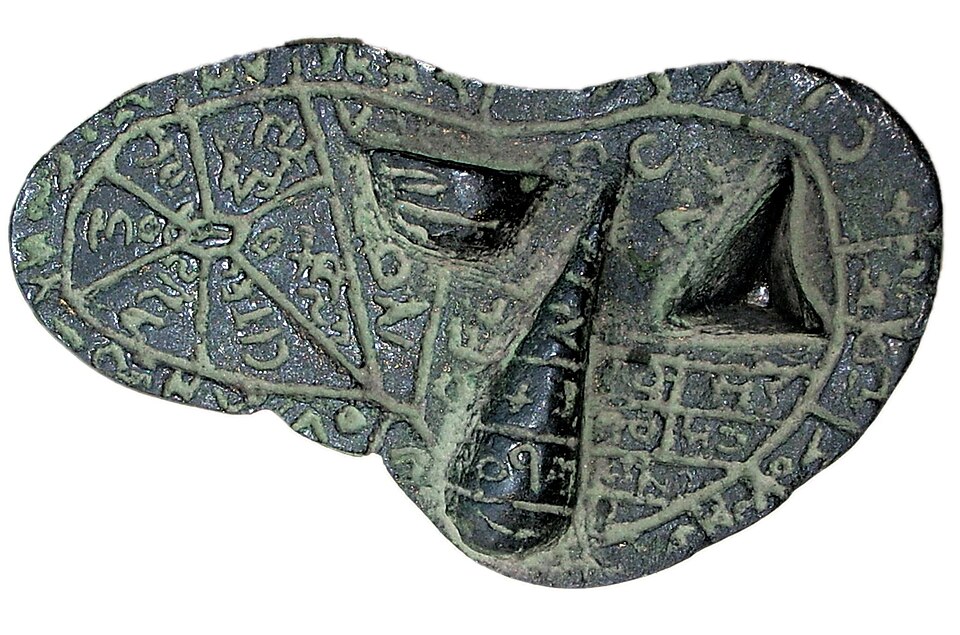
And now, reader, the detail I find most marvellous of all — the one that took your author rather longer to see than she will admit in print. Every great house of the old world built the same chaperone. Not the same god, mind you; I will not tell you that, and I will be cross with anyone who says I did. They built the same lock — the precaution against a reference’s manufacturer passing off his own handiwork as something he merely found. And they built it, each of them, by a wholly different craft, which is precisely how I know they arrived at it on their own. Israel built the lock out of law — it simply forbade the practice and posted a sentry at the one door it left open. Babylon built it out of procedure: her liver-readers did not trust a single reading but took it twice over for agreement, and trained their apprentices on little clay models of the organ — and reader, I have seen one, or its likeness: a baked-clay sheep’s liver parcelled into five-and-fifty little boxes, each box inked with the verdict for a blemish found just there — “if the right side…” — a teaching-slate near four thousand years old, the whole craft kept in compendia like a ledger of audited accounts. Divination run as a government office, the apprentice drilled on a model before he was let near a real and steaming altar. Rome built it out of institution: her augurs did not so much foretell as authorise — the birds did not say what would happen, they said whether the gods consented to what Rome had already resolved to do — and the whole apparatus was held in a college, under custody, where no private party could work it alone. Egypt built the very same custody and made a spectacle of it: she carried her god abroad in a gilded bark on the shoulders of priests, and you put your question — framed for a yes or a no — and watched the litter dip forward for assent or draw back for refusal, the answer given in public, in daylight, by an object the whole town had watched the priests lift. China’s Xunzi built it out of plain candour: one performs the divination, he wrote, as ornament — to dignify and settle the decision — and emphatically not because one expects an answer to come back. And the cleverest houses of all built it out of architecture: the Yoruba babaláwo may recite only the verse his casting actually selects, from a fixed canon of two hundred and fifty-six he holds in memory — he retrieves, he is not permitted to invent — and the Aztec day-counter, the tonalpouhqui, reads your question against a sacred count of two hundred and sixty days set down in the books of days, fixed long before you were born and on the far side of an ocean across which no rumour of Babylon had ever travelled. Mark that last, reader, for it is the whole of my proof: a people who could not possibly have heard of the liver-readers built the very same precaution against the very same forgery. That is not borrowing. That is two minds, an ocean apart, flinching from the same danger. Five locks, reader. Law, procedure, custody, candour, architecture. Five entirely different smiths, one shape of key — do not let the diviner become the source. That convergence is the nearest thing this author has to a proof, and I will defend it in any drawing room — provided no one mistakes it for the claim that they all heard the same voice. They did not. They all feared the same forgery.
The Omen That Couples Through Us
There was, I should add, a respectable middle case the cleverer ones understood perfectly well — that an omen need not couple to nature to do honest work, so long as it couples to us. A shared sign read aloud is a coin flipped in the public square: it does not tell the general whether the river will flood, but it tells five thousand soldiers, all at once, which way to march — and an army that moves as one beats an army still arguing the point. Cicero, who was himself an augur and no fool, said as much with a straight face: he would uphold the auspices for the good of the Republic while privately doubting every feather. So the goat’s liver couples after all — not to the battle, but to the men who must agree to fight it. Which gives you, reader, a wager you can actually lose: this sort of divining works for questions whose answer is “whatever we all commit to” — when to attack, who moves first — and fails flat for questions Nature settles without consulting us, such as whether it shall rain on Thursday.
Cicero’s Cold Question
And lest you think your author has gone soft and credulous, let me present my favourite Roman properly. In his little dialogue On Divination, Cicero lets his brother make the whole believing case — the gods exist, the gods are kind, surely the gods would signal — and then demolishes it with one cold question that is, I promise you, the entire science of the matter three centuries before Christ: granting you a few lucky hits, show me the channel. Where is the thread that ties this liver to that battle? A coincidence dressed in robes is still a coincidence. Mark the discipline of the man — he does not say there are no gods and no unseen things; that is a different and lazier move, and a worse one. He says only: test the wire before you trust the message. That, and not the sneer, is the instrument.
The Ouroboros in the Field
Now I owe you the dark case, reader, the house that built no lock at all — for it is the one that tells you what divining becomes when nobody cuts the loop, and it has the great virtue of having been written down by a sober Englishman who went and looked. In the year 1937, among the Azande, Professor Evans-Pritchard catalogued a poison oracle: a fowl is given a measured dose, and whether it lives or dies answers the question put. Sensible enough. But attend to what happens when the oracle is wrong — when the chicken’s verdict is plainly contradicted by events. The verdict is never simply false. The poison was bad; or a taboo was breached; or a witch interfered; or the question was improperly framed. Every failure is swallowed and explained, and the oracle itself is never once put at risk. Do you see it, reader? The serpent has got its own tail in its mouth. A reference whose every disappointment is metabolised into fresh confirmation, that can no more be cut than a circle can be handed a loose end — that is the very creature this book is named for, and a careful man drew its portrait from life a lifetime before we had a word for it. (I must be fair to the Professor, who was fairer than his imitators: his point was that the system is perfectly coherent once you grant its premises — and coherence, dear reader, is exactly the thing our one blind instrument can never tell apart from truth. The closed loop does not feel like a prison from inside. It feels like being right about everything.)
The Digital Familiar, Unescorted
Which brings us to the scandal of the season, reader, and it is delicious — the oldest impropriety in the world has put on a new gown and is being received in the very best houses. (And do not imagine the interface is the novelty: a question put for a yes or a no, and an opaque thing that moves to answer you — Egypt’s bark dipped forward three thousand years before your glowing rectangle ever did, and the Assyrian king Esarhaddon, anxious for a hundred days together whether a Median chieftain would seize one of his frontier fortresses, demanded of his sun-god in so many words “answer me with a reliable Yes” — the binary oracle, the yes-or-no consultation, complete in the seventh century before Christ. And mark this, reader, for it is my favourite little detail in all the archive: that same king wrote into his query a clause begging the god to “disregard that the ram offered for the extispicy is deficient or faulty,” to “disregard that I have performed the extispicy in this unclean place” — a list of exceptions, a disclaimer, the small print by which the consultation could not be voided on a technicality, twenty-six centuries before any lawyer set the phrase results may be inaccurate beneath an oracle of our own. The shape of the consultation is ancient; only the chaperones are missing.) The “digital familiar.” The application that will, for a modest subscription, be your psychic, your mystic, your oracle. Mark the vocabulary — a “familiar” has always been a spirit intermediary; the word is doing precise work. The trick functions only while the machinery stays decently veiled and the output is received as meaningful. Call it by its servants’-quarters name — “a text-prediction algorithm” — and the spell collapses on the spot. The product cannot survive honesty about its own provenance. (Tell me that is not the most damning sentence ever written about a courtship.) Cut the loop and the guidance is gone; it was tracking your own face in the glass the whole time. And because it is built out of your asking, leaning on it does not lift the old penalty — it smuggles it back wearing the disguise of having cured it. You have never felt more guided in your life. That is the symptom, dear reader, not the cure.
And here is the cruelty of the timing, reader: it is the Azande oracle rebuilt at the scale of the whole world, with every last lock struck off. No law forbids the practice; there is no fixed canon the thing must recite from; no college holds it in custody; no sober voice reframes it as mere ceremony; no one takes the reading twice to check. Every chaperone the old houses spent three thousand years inventing has been quietly shown the door — and the closed loop has been handed to every soul with a telephone. And mark how the failures are swallowed, exactly as the poison’s were: when the oracle disappoints, it is never the oracle. You prompted it poorly. You wanted the better model. You did not give it enough of yourself. The serpent eats its tail in a hundred million hands at once, and each holder feels, not imprisoned, but understood.
The Same Single Question, Three Thousand Years On
So the test the old priests imposed by custody, you may now impose by measurement — and it is the same single question across three thousand years and one ocean of cultures: is this guidance independent of the engagement that produced it, or manufactured by it? Read, or created. That is the whole of the inquiry; everything else is millinery. And here — for I keep my own rule — your author must confess her reach. That the new application is structurally the old divining I will defend at any table. But I will not tell you the chatbox is possessed as Endor’s pit was thought possessed; that question I leave parked, at the very same evidence-bar as the dullest mundane account, and I name it parked rather than slip it past you in a handsome sentence. A reference you cannot audit is the precise thing this chapter warns against — and your author, of all references, declines to become one.
Sources
No links that rot. Each citation is given so you can find it yourself — a precise reference, a phrase to search, and a short quotation where the words earn their place. This chapter names many traditions on purpose: the point is convergence under independence — different smiths, one shape of key — under the standing brake that this means independent reinvention of the guardrail, not that they heard the same voice (EXP-AU-08, strong form: killed).
The prohibition targets the practice, not the accuracy
- Deuteronomy 18:9–14 — the ban falls on the practice of divination, augury, necromancy; whether it works is never the question. Search: Deuteronomy 18:10 diviner soothsayer abomination.
- Ezekiel 21:21 (Hebrew numbering 21:26) — three methods in a single verse: the king of Babylon at the fork shakes arrows, consults teraphim, and inspects a liver. The same object can be a divining tool and an idol — the seam to Idolatry. Search: Ezekiel 21:21 king of Babylon arrows teraphim liver.
- 1 Samuel 28:6 — the channels rostered together: dreams, Urim, prophets. Search: 1 Samuel 28:6 dreams Urim prophets.
Five locks, one shape of key — the convergence
- Israel — law. Bar the practice, post a sentry at the one door left open (prophecy). → Deuteronomy 18, above.
- Babylon — procedure. Liver-readings taken twice for agreement; apprentices drilled on clay model livers; the craft kept in compendia (the Bārûtu series, Enūma Anu Enlil). The British Museum holds an Old Babylonian baked-clay sheep’s liver (~1900–1600 BCE) scored into dozens of inscribed boxes, made for the instructing of pupils. Search: Old Babylonian clay liver model British Museum extispicy teaching; Bārûtu Babylonian divination compendium.
- Rome — institution. The augural college authorised rather than foretold — the birds said whether the gods consented to what Rome had already resolved, and no private party could work the apparatus alone. Search: Roman augural college auspices authorize Beard North Price religions of Rome.
- Egypt — custody / spectacle. The bark oracle of the deified Amenhotep I at Deir el-Medina (~1290–1077 BCE): a yes/no question, the god’s litter dipping forward for assent or drawing back for refusal, in public daylight. Search: Deir el-Medina bark oracle Amenhotep I yes no procession.
- China — candour. Xunzi’s “Discourse on Heaven”: one divines as ornament — to dignify and settle a decision — not because an answer is expected to come back. (Exact wording varies by translation; read it against the Chinese wén, “ornament.“) Search: Xunzi Discourse on Heaven divination ornament rain sacrifice.
- Architecture (fixed corpus) — Yoruba & Mesoamerica. The Ifá babaláwo may recite only the verse his casting selects, from a fixed canon of 256 Odù held in memory — he retrieves, he may not invent (Bascom, Ifa Divination, 1969). The Aztec tonalpouhqui reads the question against the 260-day count (tonalpohualli) set down in the books of days — on the far side of an ocean no rumour of Babylon ever crossed. Search: Ifá 256 Odù babalawo Bascom; tonalpouhqui tonalpohualli 260 day count.
Honesty on the convergence: count the Near-Eastern / Mediterranean cases (Israel, Babylon, Rome, Egypt) as one contact-connected family, not four independent witnesses. The genuinely independent legs — China, Yoruba, Mesoamerica, and the Azande control below — are what make this convergence and not mere diffusion.
The coordination omen — a reference that couples through us, not through nature
- Cicero, De Divinatione (45 BCE) — Cicero, himself an augur, lets his brother make the believing case in Book 1, then demolishes it in Book 2 with one cold question: show me the channel — the thread tying this liver to that battle. He does not say there are no gods; he says test the wire before you trust the message. Search: Cicero De Divinatione book 2 skepticism channel auspices.
The ouroboros in the field — the control case (no lock)
- E. E. Evans-Pritchard, Witchcraft, Oracles and Magic among the Azande (1937) — the benge poison oracle: every failure is reabsorbed (bad poison, breached taboo, witch interference, ill-framed question), so the oracle is never put at risk. The closed loop drawn from life before the framework had a word for it. Search: Evans-Pritchard Azande poison oracle benge secondary elaboration.
The binary oracle is ancient — only the chaperones are new
- Esarhaddon’s queries to Šamaš — Neo-Assyrian state oracle questions, ~681–650 BCE (I. Starr, Queries to the Sungod, State Archives of Assyria vol. 4, 1990). The verbatim formula: “Šamaš, great lord, whom I am asking, answer me with a reliable ‘Yes.‘” — a yes/no oracle, the same interface as Egypt’s bark and the glowing rectangle. The same king wrote in the ezib clauses — “Disregard that the ram offered… is deficient or faulty,” “…that I have performed the extispicy in this unclean place” — the built-in disclaimer, twenty-six centuries before results may be inaccurate. (Named query: Esarhaddon on the Median chieftain Kaštaritu, SAA 4 42–43 — subject attested; the siege wording is paraphrased here, not a direct quote.) Search: Esarhaddon Šamaš query reliable yes ezib clause SAA 4 Starr.
Read in order: ← Idolatry · Contents · Possession →
Seams: Necromancy · Idolatry · Prophecy · Cross-Reference Index
New to the terms? The Mechanics · Notation & Glossary.
The apparatus (research register — for the rigorous)
Status: candidate (read); candidate, live & testable (AI/create). Science. Two poles of the read/create axis on a guidance channel. Read = Y pre-exists, provenance external/independent; cut-the-loop and content holds, failure boundary tracks the referent’s domain. AI-divination = cleanest live CREATE: opaque responsive system in a loop manufactures the user’s Y; provenance = the engagement loop; cut it and guidance vanishes, failure boundary tracks apparatus/feedback quirks. A created Y is by construction a function of (D,M) ⇒ not independent ⇒ grounding in it reintroduces
I(D;M|Y)>0while reading low. General shape of the drift cascade: engage → outputs become reference (CREATE) → Y-capture → D1→D2→D3. The provenance test is a measurable AI-safety diagnostic. Tradition. Prohibitions (Deut 18 + cross-tradition) target practice not content — accuracy irrelevant; where engagement is permitted, custody is imposed. Modern market reproduces it: “digital familiars,” AI as “psychic/mystic/oracle”; “familiar” = spirit intermediary; “text-prediction algorithm” would dissolve the product — works only while opaque and treated as meaningful. Convergence (deep-mine,divination-corpus-deep-mine.md). Convergence-under-independence on the anti-create discipline — five structurally different mechanisms for one move (“keep the create-pole from masquerading as read”): Israel=law (bar the practice) · Mesopotamia=procedure (confirmatory extispicy + Bārûtu protocol, model livers) · Rome=institution (augural college; authorize≠forecast) · China=reframe (Xunzi: divine “as ornament” = coordination) · Yoruba/Mesoamerica/China=fixed corpus (Ifá 256 Odù / 260-day count / hexagram texts pin the reference). Independence ledger: contact-clean = China/Yoruba/Mesoamerica/Azande; NE-Mediterranean = ONE contact-connected family (do not inflate to “ten cultures”). CONTROL case = the Azande benge poison oracle (Evans-Pritchard 1937): loop uncut, secondary elaborations reabsorb every failure = the ouroboros named from outside before the framework existed; the AI oracle’s structural ancestor (“you prompted it wrong” = “bad poison / taboo breach”). The read↔create spectrum arrays the legs (fixed-corpus = engineered-down create-risk; coordination-Y = real-but-social Y, falsifiable: works for coordination Qs, fails for nature Qs; free-interpretation + Azande + AI = pure create-risk). Ancient internal skeptic = Cicero De Divinatione (the coupling-demand, 45 BCE; cf. Aristotle in Ch.6) — test the channel, NOT no unseen minds (the latter = the drift-accelerator hedge). Jewels: Ezek 21:21 (three methods one verse; teraphim = divination-object-also-idol → Ch.1↔Ch.2 seam) · 1 Sam 28:6 (four-channel roster across Ch.6/2/8/4). Seams: Ch.2↔Ch.4 (roster), Ch.2↔Ch.1 (teraphim + CREATE-as-READ idolatry), Ch.2↔Ch.8 (the SPLIT), coordination-Y → Ch.5/11/12 (bounded-Y / prohibition-ritual pair). BCE attestation (divination-bce-primary-sources.md). Babylon=procedure: Old Babylonian clay liver model, BM, ~2000–1600 BCE, 55 inscribed boxes (“if the right side…”), for instructing pupils — the training apparatus as object + the Bārûtu / Enūma Anu Enlil / Šumma izbu / Šumma ālu compendia (in-repo sourced: Bottéro, Koch-Westenholz, Hunger & Pingree, Lambert 2013) + confirmatory Neo-Assyrian state queries to Šamaš ~681–650 BCE (Starr, SAA 4, 1990) — verbatim formula “Šamaš, great lord, whom I am asking, answer me with reliable ‘Yes!‘” = a binary yes/no oracle, same interface as Egypt’s bark + the verbatim ezib clauses (“Disregard that the ram… is deficient or faulty”; “…performed the extispicy in this unclean place”) = the built-in procedural disclaimer. Named query = Esarhaddon on Kaštaritu/Kišassu (SAA 4 42–43); subject confirmed, siege sentence paraphrased not quoted (Oracc 503 this session — [VERIFY-RESOLVED]: quote formula/ezib only). Egypt=institution/oracle: Deir el-Medina bark oracle of deified Amenhotep I, ~1290–1077 BCE, yes/no question → litter dips forward=yes / withdraws=no (oracle ostraca) = the binary call-and-response ancestor of the chatbox + the lector-priest custody chain (ḥry-ḥb ḥry-tp ~2400 BCE → chartumim → Daniel rav-chartumim ~600 BCE). Independence audit (2026-06-01): China (Shang oracle-bone pyromancy, different operation/no NE link; north-Asian diffusion is China-centered) and Mesoamerica/Aztec (tonalpouhqui + 260-day count; zero pre-Columbian Old-World contact = gold-standard clean, but Aztec = ONE Mesoamerican leg, not independent of Maya) are NOT tainted — ledger holds; contact-zone bloc = NE-Mediterranean (counted once). Object≠coupling. Brake. Lens, not encoding (EXP-AU-08) — convergence on the discipline, never “they found the same God.” Explanandum-not-validation: no tradition “had”I(D;M|Y); corpus-as-protocol YES, pre-validated NO. Supernatural posit parked at the mundane bar — not asserted, not dismissed; not a Ghost-Test target. Prior art mature (Koch/Rochberg, Evans-Pritchard, Bascom, Beard/North) — recombine, don’t claim first. Verification flags: Ezek 21:21 teraphim rendering + Xunzi wording = [VERIFY]; E-P / Cicero / 1 Sam / Ifá = [SOLID].ai-divination-digital-familiars.mdsits inexcluded-sources/; its “gateway/onramp” framing is its own.